AI Email Marketing: A Practical Guide for UK Businesses
Posted On: July 28, 2026
Last updated: August 2026 · Written by Rodi Taze, Co-Founder of AI Workforce · Reviewed by Seth Ayush, Co-Founder of AI Workforce
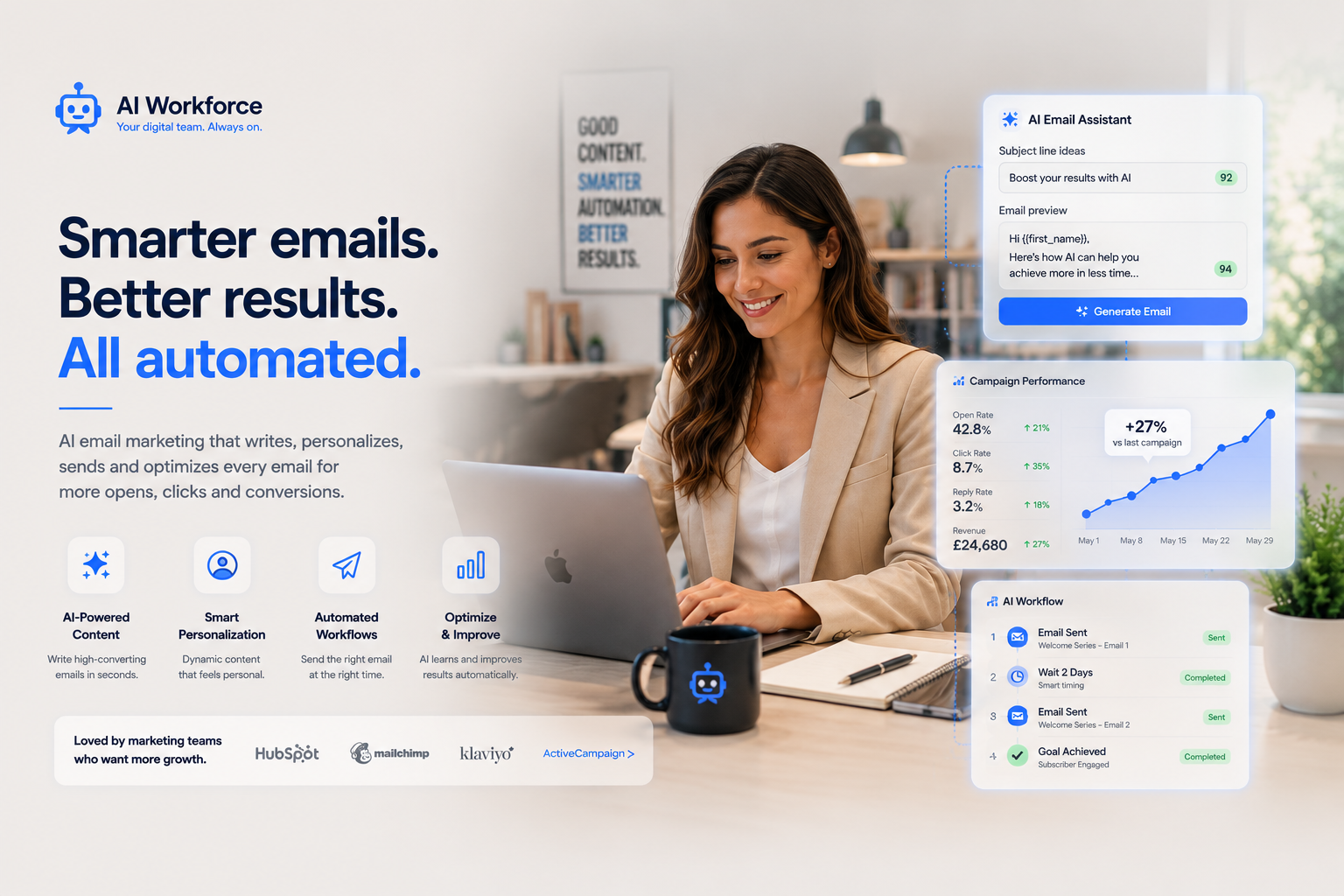
Getting a good send right used to rely on guesswork: which subject line will land, which send time will work, which segment will actually convert. AI has closed a lot of that gap, but only when it is governed properly. This guide explains how AI email marketing actually works, what it should and should not be trusted to automate, and how to measure results without leaning on a metric that has become increasingly unreliable.
Quick Answer: AI email marketing uses artificial intelligence to draft copy, test subject lines, segment a list by real behaviour, pick send times, and report on performance, across newsletters, lifecycle and promotional sends made under consent, a valid soft opt-in, or other permitted circumstances such as B2B marketing to a corporate subscriber. It works best when a person still reviews anything customer-facing, sensitive, or time-critical before it sends, and when success is measured by clicks, conversions and revenue rather than open rate alone, since open rate has become a much less reliable signal in recent years.
At a Glance
What it is: AI applied to permissioned email marketing, newsletters, lifecycle and promotional sends made under consent, soft opt-in, or permitted B2B circumstances, drafting, segmentation, send-time optimisation and reporting, distinct from cold outreach or one-off follow-up automation
Best suited to: teams sending regular newsletters, lifecycle or promotional email to a subscribed list who want less manual admin without losing brand voice
Biggest benefit: less time spent on subject line guesswork, manual segmentation and send-time scheduling
Biggest risk: trusting an unreviewed AI draft, or an open-rate figure, more than either currently deserves
Key legal considerations: PECR for electronic mail marketing, UK GDPR for any identifiable subscriber, and the right to object to direct marketing at any time
What's Covered
What Is AI Email Marketing?
AI Email Marketing vs Cold Email vs Follow-Up Automation vs Marketing Automation
The AI Workforce Email Model
What Can AI Actually Automate in Email Marketing?
How Does AI Improve Subject Lines and Copy?
Segmentation and Send-Time Optimisation
What Should AI Never Do in Email Marketing?
Which AI Email Marketing Tools Are Worth Considering?
UK GDPR and PECR for Email Marketing
How Should You Measure Results?
A Four-Week Rollout Plan
Is AI Email Marketing Worth It?
Related Guides
Frequently Asked Questions
Key Takeaways
What Is AI Email Marketing?
AI email marketing applies artificial intelligence to newsletters, lifecycle, promotional and other permissioned marketing-email workflows, including campaigns sent under consent, a valid soft opt-in, or other permitted circumstances such as B2B marketing to a corporate subscriber: drafting copy, testing subject lines, segmenting contacts by real behaviour rather than guesswork, choosing a send time, and summarising performance. Generative AI can draft a full email in seconds, and machine learning can look at how a list has actually engaged with past sends to inform the next one.
None of this replaces a marketing team's judgement. It removes the routine parts of the job so a person can spend more time on strategy, offer design and brand voice, and less time on scheduling and first-draft admin. AI email marketing works best alongside someone who understands the brand and reviews what goes out, not instead of them.
AI Email Marketing vs Cold Email vs Follow-Up Automation vs Marketing Automation
These four categories get blurred together often, and treating them as one thing leads to the wrong tool, and sometimes the wrong compliance treatment, being applied to the job.
AI email marketing (this guide) covers sending to an existing marketing-email list under consent, soft opt-in, or another permitted basis such as B2B corporate marketing: newsletters, lifecycle emails, promotions and re-engagement campaigns.
Cold email covers one-to-one outbound to people who have not opted in, with its own deliverability, verification and warm-up considerations. Our cold email tools guide covers that category in depth.
AI follow-up automation covers the sales-specific job of tracking an open conversation and deciding when the next touch is due. Our follow-up automation guide covers reply classification and CRM state in more depth.
AI marketing automation is the broader, cross-channel layer that email marketing sits inside, alongside ads, social and web personalisation. Our AI marketing automation guide and AI marketing agents guide cover that wider layer and its governance model.
Knowing which of these four a specific task actually is matters, because the compliance rules and the acceptable level of automation differ between them, particularly between an opted-in list and cold outreach.
The AI Workforce Email Model
A single send is not one decision. It is a sequence of smaller ones, and treating it as one step, write and send, is where a lot of AI email marketing goes wrong. At AI Workforce, we use an Email Model built on six stages.
Audience: who should receive this email, based on real segmentation criteria rather than "everyone on the list"
Trigger: why this email is going out now, whether that is a scheduled newsletter, a behavioural trigger, or a lifecycle stage
Content: what approved information, offers and brand voice the system is allowed to draw on when drafting
Review: whether this specific message needs a person to check it before it sends, and who that person is
Send: when, through which list, and at what time the message actually goes out
Learn: what happened after the send, and what that means for the next one
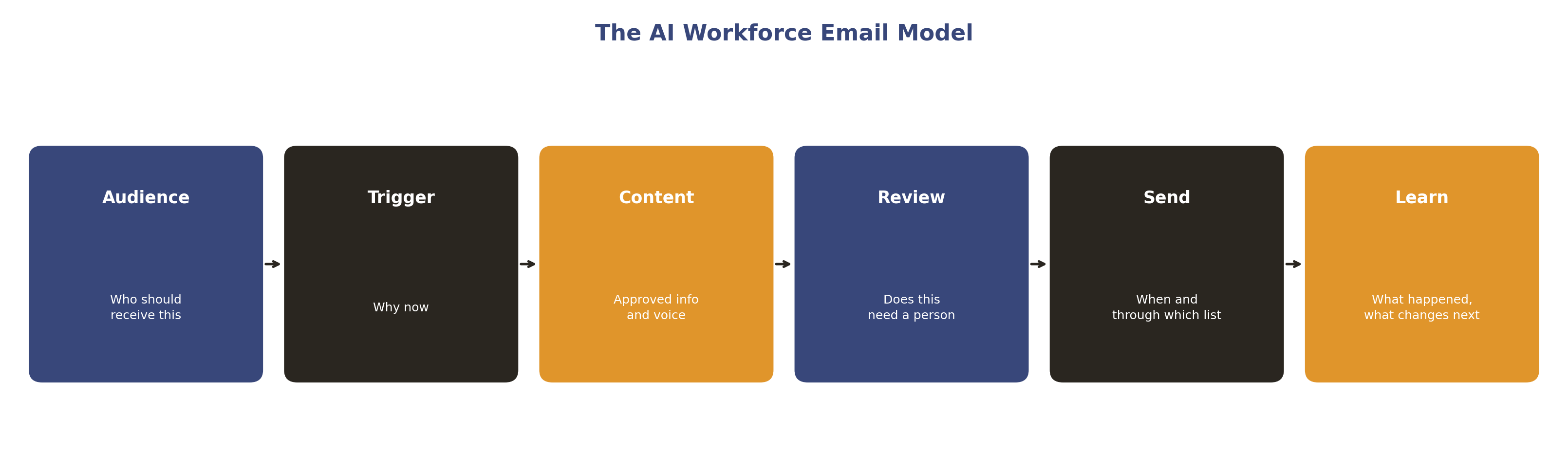
Illustrative model. The specific rules behind Review and Send should reflect your own brand and compliance requirements.
AI Workforce Insight: AI can draft, segment, time and report. A person still decides what the brand says, and reviews anything sensitive before it reaches a subscriber's inbox.
The Review stage is the one most generic email tools skip over, and it is the one that matters most for a regulated or high-stakes list. Not every send needs the same level of scrutiny, but every send should have a defined answer for who is responsible for checking it, rather than assuming the AI draft is ready to go as written.
What Can AI Actually Automate in Email Marketing?
An AI-supported email marketing setup typically automates three things well: drafting, segmenting and reporting.
On drafting, generative AI can produce a full first draft of a newsletter or campaign email, along with several subject line variants, in a fraction of the time a blank page takes. Editing a reasonable draft is usually faster than writing one from scratch, and a first draft built this way tends to launch a send earlier in the week rather than later.
On segmentation, AI can group a list by actual engagement and behaviour, who opened recent sends, who clicked a specific link, who has gone quiet, rather than a static tag someone set up months ago and never revisited. Basic automation used to mean a single sequence sent to everyone the same way; AI-supported branching can vary which email a contact receives next based on their own recent behaviour.
On reporting and list hygiene, AI can flag a rising unsubscribe rate, tag genuinely disengaged contacts for a re-engagement or suppression decision, and summarise a campaign's performance without a person pulling the numbers manually. This is where a meaningful share of the weekly admin time actually goes, and it is one of the more reliably safe places to let automation run with lighter oversight.
How Does AI Improve Subject Lines and Copy?
Writing a subject line that actually gets opened is one of the harder parts of the job, and it is where AI subject-line testing tools make a genuine difference: generating several variants and testing them against each other before the full send goes out, rather than a single guess going to the whole list.
This extends into the body copy too. AI drafting tools can produce a first pass at the full email, and personalisation has moved well beyond a first-name merge tag into content blocks that vary by segment or recent behaviour. Whether an AI-drafted email performs better than a rushed manual draft depends on the quality of the data behind it and the review it gets before sending, not on the fact that it was AI-generated. Treat an AI draft as a strong starting point that still needs a human read-through for tone, accuracy and brand fit, particularly on figures, pricing and anything time-sensitive like an offer end date.
Segmentation and Send-Time Optimisation
Send-time optimisation is one of the clearest, lowest-risk early wins in this category, because getting it wrong simply means a slightly less optimal delivery time, not a compliance or brand problem. Tools such as Klaviyo and Mailchimp both offer send-time features that learn when an individual subscriber tends to engage and deliver to each contact around that time, rather than sending the whole list at one fixed hour.
Segmentation built on real behaviour, rather than a static list someone tagged manually, tends to keep a list healthier over time, since contacts who have genuinely disengaged can be moved into a re-engagement sequence or considered for suppression before they start dragging down deliverability for everyone else. This is a genuinely well-suited task for automation: the criteria are usually objective (opened, clicked, purchased, gone quiet for a defined period) and the consequence of an imperfect segment is limited, unlike a wrongly sent promotional claim or an unreviewed regulated message.
What Should AI Never Do in Email Marketing?
This is the part a generic "AI can help with email" guide tends to skip, and it is the one that actually protects a brand and a sender's list.
An AI email marketing system should never invent a product claim, statistic or feature that has not been verified, fabricate a personalisation detail about a specific subscriber, change wording that has been through legal or compliance review, send to a contact on a suppression list, override an unsubscribe or objection, use an unverified price, date or offer detail, or send a promotional or high-risk campaign without a person reviewing it first. It should not decide on its own that a disengaged contact should be permanently removed from marketing without a defined re-engagement or suppression process behind that decision, and it should not be relied on to determine, on its own, whether a specific send actually complies with PECR or UK GDPR.
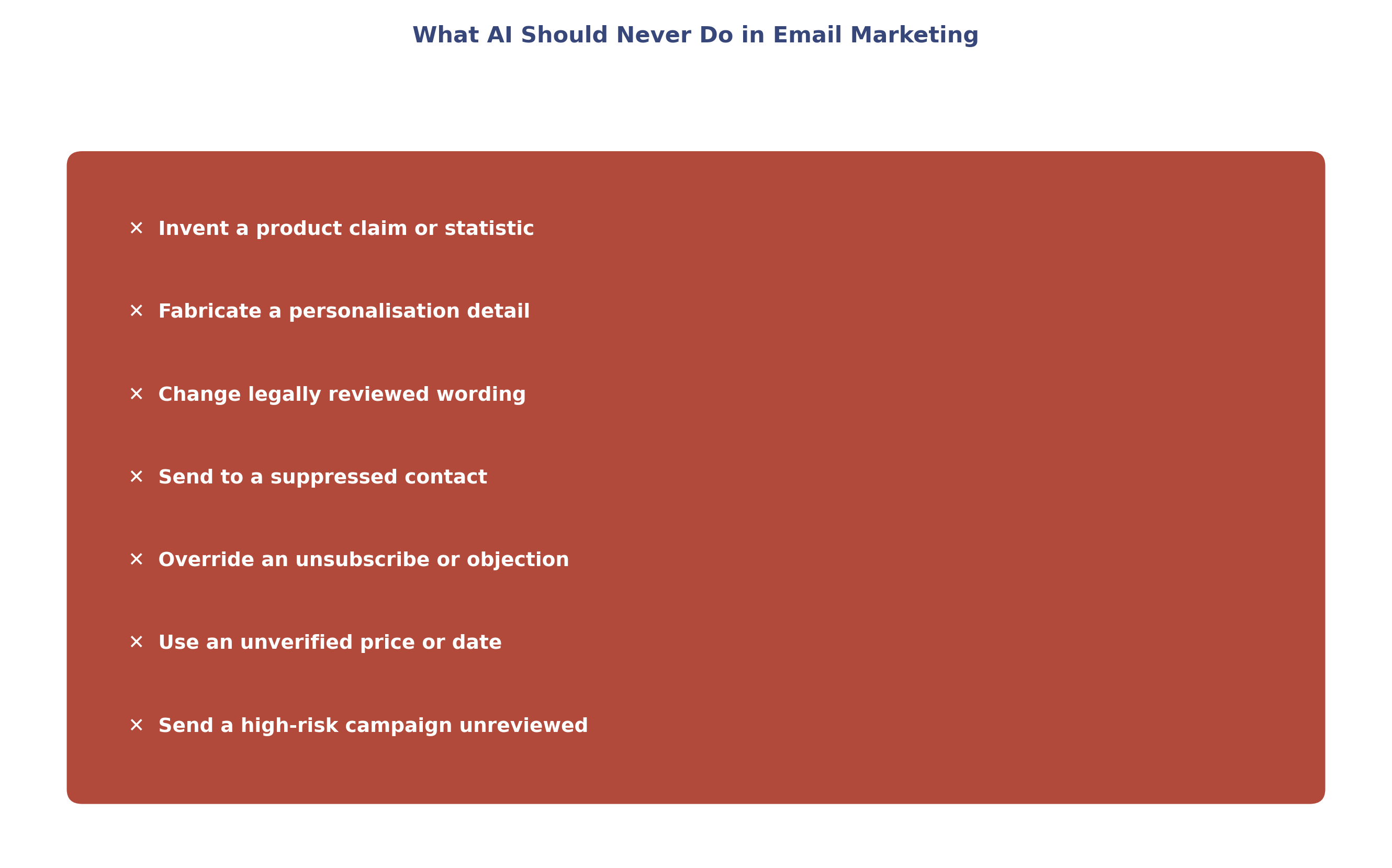
Illustrative list. Your own brand and compliance policy should determine the full scope of what needs human review.
Collecting a subscriber's engagement data is not the same as deciding what a business is legally or ethically allowed to say to them. Keeping those two things separate is what makes an AI-supported email programme trustworthy rather than merely fast.
Autonomy is not all-or-nothing either. It helps to set the right level activity by activity:
Subject-line variants: high AI autonomy, spot-checked rather than reviewed line by line
First draft copy: AI drafts, human review required before the campaign sends
Send-time optimisation: high AI autonomy once the underlying rules are pre-approved
Behavioural segmentation: AI proposes segments, a person reviews the logic behind them
Welcome or lifecycle sequence: higher AI autonomy once tested, with periodic review rather than per-send approval
Promotional offer: AI can draft, but a person must approve before sending
Pricing change or time-sensitive detail: low AI autonomy, human verification required every time
Legal or regulatory wording: low AI autonomy, required human review
Suppression and unsubscribe status: enforced by the system automatically; AI must never override it
Illustrative example: a software company wants to promote a September upgrade offer. AI identifies contacts who clicked product-related emails in the previous 60 days, drafts three subject line variants and a first email, and recommends an individual send time for each contact. A marketer checks the price, the offer end date and who is actually eligible before approving the campaign. After sending, the team judges the campaign on click-to-conversion rate and revenue rather than treating a strong open rate as success on its own.
Which AI Email Marketing Tools Are Worth Considering?
Rather than ranking a fixed list, since features and pricing in this category change often, it's more useful to understand the categories. Options range from simple send-time optimisers bolted onto an existing platform to full-suite tools that handle drafting, segmentation, sending and reporting together.
Established platforms such as HubSpot, Klaviyo and Mailchimp have all built AI capability into their existing email tools: subject-line and full-draft generation, send-time optimisation at the individual subscriber level, and predictive segmentation are increasingly available across established email platforms, although availability varies by product and subscription tier. Larger marketing-cloud products bundle email alongside other channels, while smaller, focused options tend to do the email job particularly well without the wider suite. Which fits best depends on list size, how much of the wider marketing stack you want in one platform, and how much manual control your team wants to keep over drafting and sending.
A tool with strong AI features but poor integration into the platform your list already lives in will cause more admin than it saves. Confirm integration with your existing email platform and CRM before evaluating any AI feature on its own merits, and test a free trial against a real, small segment of your list before committing to an annual contract.
UK GDPR and PECR for Email Marketing
Email marketing to an opted-in list still carries real UK compliance obligations, and AI does not change who is responsible for meeting them. This section is general information rather than legal advice.
PECR governs marketing by electronic mail, and it treats corporate subscribers, meaning companies, limited liability partnerships, Scottish partnerships and some government bodies, differently from individual subscribers, meaning private individuals, sole traders and most non-limited partnerships. Marketing email to an individual subscriber generally needs consent or a valid soft opt-in from an existing customer relationship. If you are not sure which category a contact falls into, treat them as an individual subscriber.
UK GDPR applies regardless of subscriber type wherever a record identifies a person. You need a documented lawful basis, and any subscriber has an absolute right to object to their data being used for direct marketing at any time, which must be honoured immediately once it arrives, not queued for the next list-cleaning pass.
Tracking pixels used for open measurement are themselves a PECR point, not just a UK GDPR one, since they store or access information on a recipient's device. This applies to every subscriber, not only individuals. Unless an applicable PECR exemption applies, storage or access technologies generally require valid consent, so a pixel used purely to measure opens should not be assumed to be automatically covered by the same basis used to justify the marketing send itself.
An AI email marketing system should be configured to check suppression and opt-out status before every send, not only at the point a list is first uploaded. Our guide to AI and GDPR compliance for UK businesses covers the wider framework, including lawful basis and vendor due diligence, in more depth.
How Should You Measure Results?
Open rate is the metric most email marketing content still leads with, and it's increasingly the wrong one to lead with. Apple's Mail Privacy Protection preloads message content, including the tracking pixel, on Apple's own servers regardless of whether a recipient actually opens the message, which can push reported open rates toward 100% for Apple Mail recipients whether or not a person saw the email. With a large share of inbox traffic running through Apple Mail, this materially distorts the headline number most teams still report first.
Treat open rate as a diagnostic signal at most, useful for spotting a severe deliverability problem, not as the measure of a campaign's success.
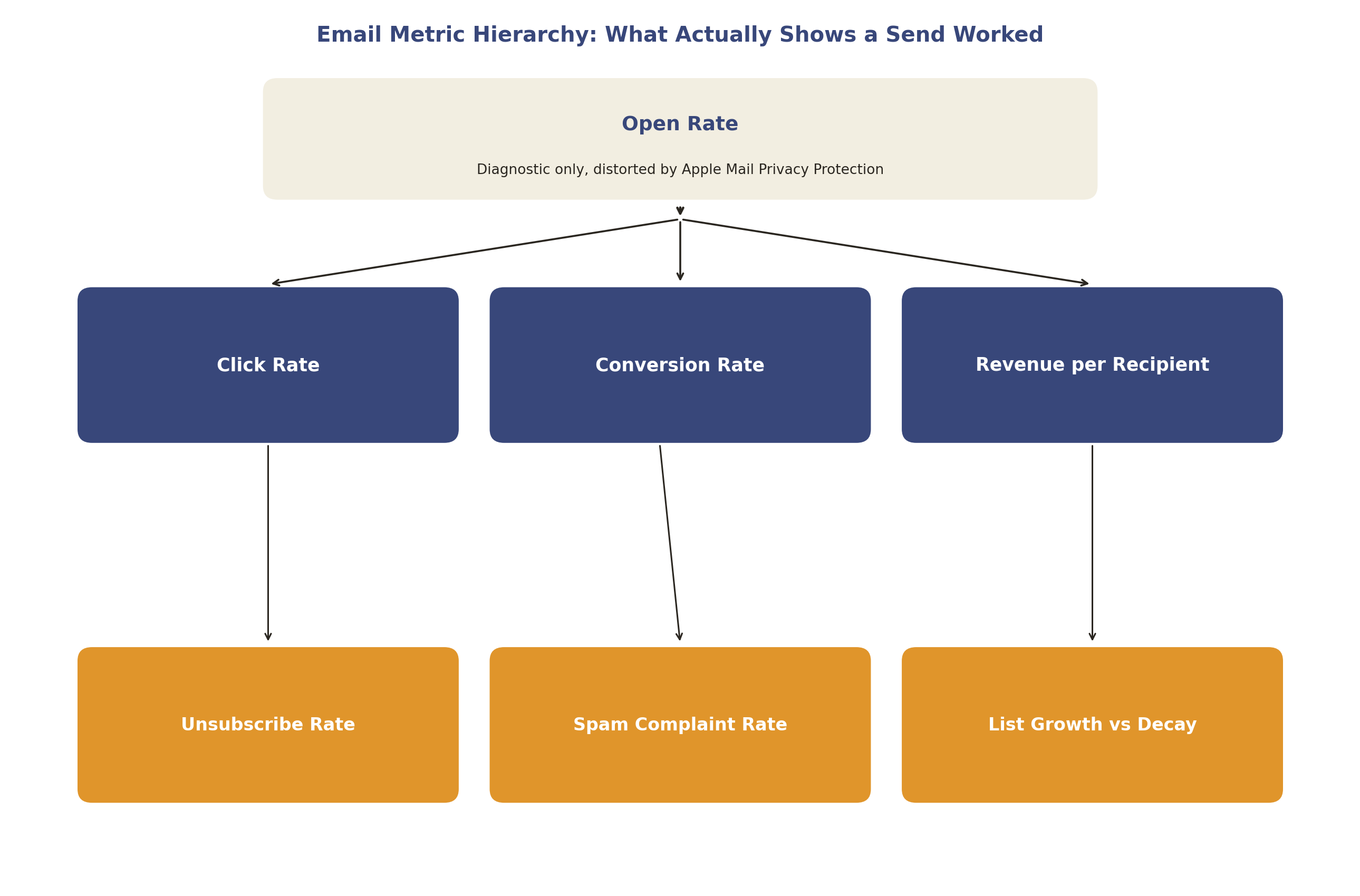
Illustrative hierarchy. Weight each metric according to your own campaign goals.
A campaign with a high open rate and a low click and conversion rate has not necessarily worked. A campaign with a modest, honestly measured open rate but strong clicks, conversions and low complaints usually has.
A Four-Week Rollout Plan
Introducing AI into an existing email programme works better as a staged rollout than an overnight switch.
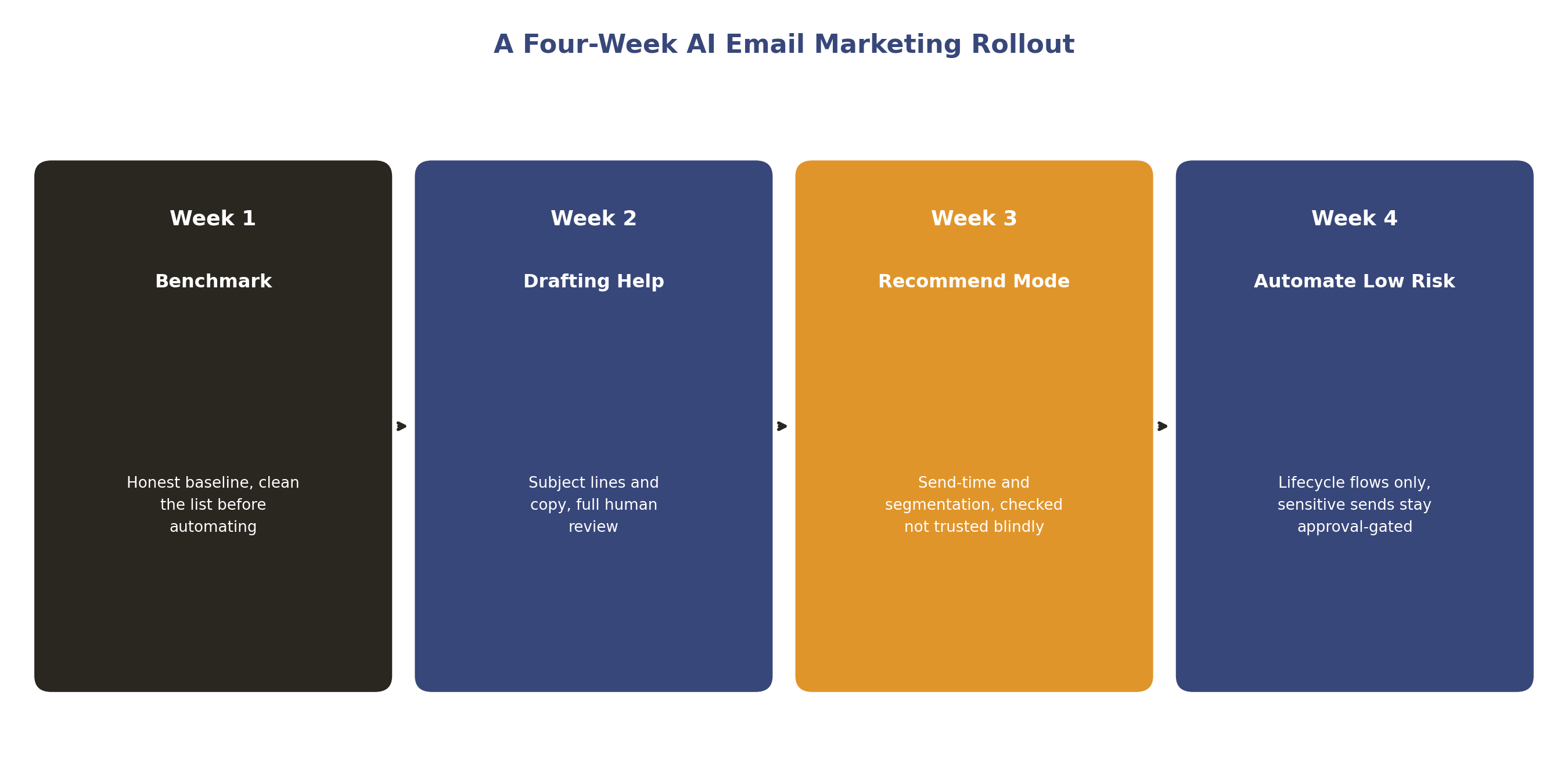
Illustrative roadmap. Expand automation only once earlier stages have proven themselves against real sends.
Week one: benchmark current performance honestly, click rate, conversion rate, revenue per send, unsubscribe and complaint rate, and clean the list of clearly invalid or long-disengaged contacts before adding automation on top of a messy base.
Week two: introduce AI for subject-line variants and first-draft copy, with a person reviewing every send before it goes out.
Week three: turn on send-time optimisation and behavioural segmentation in recommendation mode, checking the system's suggested segments against what your team would have built manually.
Week four: automate lower-risk, high-volume lifecycle flows, such as a welcome sequence or abandoned-browse reminder, while keeping promotional, regulated or otherwise sensitive campaigns on a required human-review step.
If you are not sure whether your data, review process or wider marketing stack is ready for this level of automation, our AI Readiness Assessment is a useful self-check to run before starting week one.
Is AI Email Marketing Worth It?
AI email marketing tends to deliver the most value for a team sending regularly enough that manual drafting, segmentation and scheduling are visibly eating into time that could go toward strategy and offer design. It's a weaker fit for a business sending only occasionally, where the manual admin was never the bottleneck in the first place.
Judge it against click rate, conversion rate and revenue per send, not open rate and not how many features a platform lists on its pricing page. A small team can genuinely produce the output of a larger one this way, provided review discipline holds as automation increases rather than being the first thing dropped once a workflow feels reliable.
Related Guides
Frequently Asked Questions
Is open rate still a useful metric?
Only as a rough diagnostic. Apple's Mail Privacy Protection preloads messages regardless of whether a recipient opens them, which inflates reported opens for a large share of any list. Click rate, conversion rate and revenue per send are more reliable measures of whether a campaign actually worked.
Can AI send a campaign without a person reviewing it first?
It can be configured to, but this is a higher-risk setup best reserved for narrow, well-tested, low-risk sends such as a routine lifecycle email. Promotional, regulated or otherwise sensitive campaigns should keep a human review step.
Does AI email marketing replace a marketing team?
No. It removes routine drafting, segmentation and scheduling admin so a team can spend more time on strategy, offer design and brand voice, the parts of the job that still need human judgement.
Is this the same as cold email?
No. This guide covers sending to an opted-in list. Cold email covers one-to-one outbound to people who have not opted in, with its own deliverability and compliance considerations, covered in our dedicated cold email guide.
Do UK GDPR and PECR apply to AI-drafted emails?
Yes. The rules apply to the send itself, regardless of whether a person or an AI tool drafted it. PECR governs the marketing rules for electronic mail, and treats corporate and individual subscribers differently. UK GDPR applies to any identifiable subscriber's data.
What is the safest way to start using AI in email marketing?
Start with subject-line testing and drafting assistance, with full human review. Add send-time optimisation and segmentation next, in recommendation mode. Automate only lower-risk lifecycle flows once the earlier stages have proven reliable.
Key Takeaways
AI email marketing covers drafting, segmentation, send-time optimisation and reporting for an opted-in list, and is a distinct category from cold email, follow-up automation and broader marketing automation
The AI Workforce Email Model, Audience, Trigger, Content, Review, Send, Learn, separates a send into distinct decisions rather than one step
AI should never invent a claim, fabricate personalisation, override an opt-out, or send a regulated or sensitive campaign without human review
Open rate has become an unreliable headline metric because of Apple Mail Privacy Protection; track click rate, conversion rate and revenue per send instead
PECR treats corporate and individual subscribers differently, and UK GDPR applies to any identifiable subscriber regardless of category
Roll out gradually: drafting assistance first, segmentation and send-time optimisation in recommendation mode next, then automate only lower-risk flows
This article is general information rather than legal advice. Take independent advice on data protection and electronic marketing obligations specific to your own subscriber base.
Ready to Get Started?
If your sends are taking too long to build and still underperforming, it's worth seeing how much of this can be automated without losing your brand's voice or your list's trust. Get in touch and we'll help you find the right starting point.
About the Author
Rodi Taze is Co-Founder of AI Workforce. He works with UK businesses to design AI-supported marketing workflows that keep brand voice and compliance intact as automation increases.
This article was reviewed by Seth Ayush, Co-Founder of AI Workforce, for alignment with how AI Workforce designs and governs customer-facing automation.
Reviewed: August 2026