AI for Law Firms: Practical Uses, SRA Duties and Key Risks
Posted On: August 4, 2026
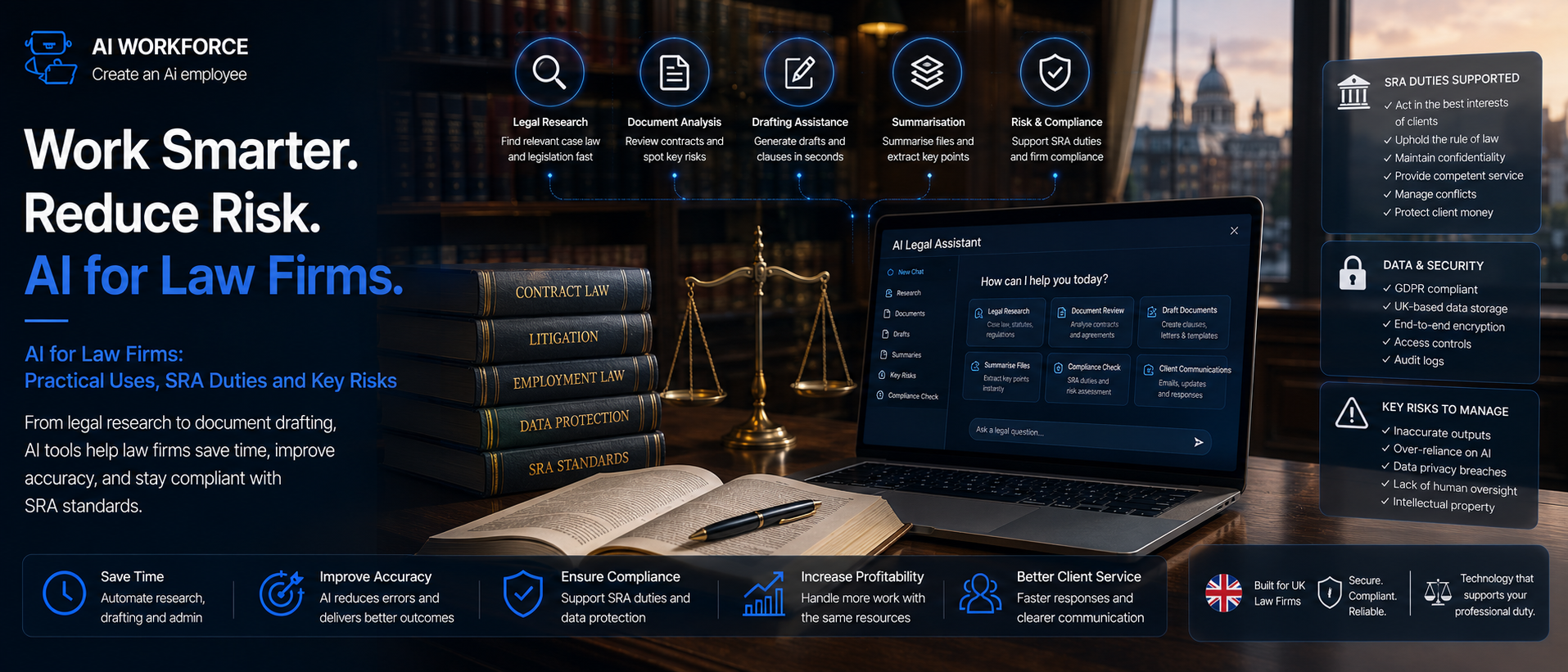
AI for Law Firms: Practical Uses, SRA Duties and Key Risks
Last updated: August 2026
Artificial intelligence is no longer an experiment for UK law firms. From document review and legal research to drafting client correspondence and analysing contracts, AI is becoming part of everyday legal practice, and legal technology more broadly, as firms invest in legal workflow automation and better matter management. The challenge is no longer whether firms should explore AI, but how to adopt it safely while protecting professional judgement, confidentiality and regulatory compliance.
Can law firms use AI? Yes. UK law firms can use AI to support drafting, legal research, document review and administrative work. However, solicitors remain responsible for competence, confidentiality and professional judgement, and AI-generated work should always be reviewed before it is relied upon or sent to a client.
Document summaries: suitable for AI, human review required
Contract comparison: suitable for AI, human review required
Meeting transcription: suitable for AI, light review
Legal research: suitable for AI, essential human review
Client advice: AI can draft only, essential human review
Court submissions: not suitable for AI, full solicitor review required
What Does AI Mean for Modern Law Firms?
In a legal context, AI generally refers to tools that can read, summarise or draft text, extract information from documents, or flag patterns across a large volume of material. Generative AI, the type behind tools like ChatGPT and Copilot, gets the most attention because it can produce a first draft rather than just search or classify existing text. Much of this sits under the broader umbrella of lawtech, alongside more established document management and matter management systems.
None of this is a single technology. A firm might use one system for transcription, another for contract review, and a third for drafting client updates, each with a different risk profile and a different level of oversight required.
In our experience, firms that begin with administrative workflows, such as meeting notes, document summaries and enquiry triage, usually achieve quicker adoption than those attempting to automate legal drafting immediately. Starting with lower-risk tasks allows lawyers to become comfortable with the technology before introducing it into more complex legal workflows.
How Are Law Firms Using AI Today?
Adoption varies considerably by firm size, practice area and risk appetite. Larger firms with dedicated innovation and legal operations teams tend to pilot new tools on a single practice group before rolling them out more widely, while smaller firms are often experimenting with general-purpose tools already available to staff. The same pattern is playing out across other regulated professions, from accountants to financial advisers, where compliance concerns are shaping adoption in similar ways.
Many firms are trialling document review, contract analysis and first-draft correspondence. Some clients increasingly expect faster turnaround and more efficient service, but firms still need to protect accuracy and confidentiality while meeting that expectation.
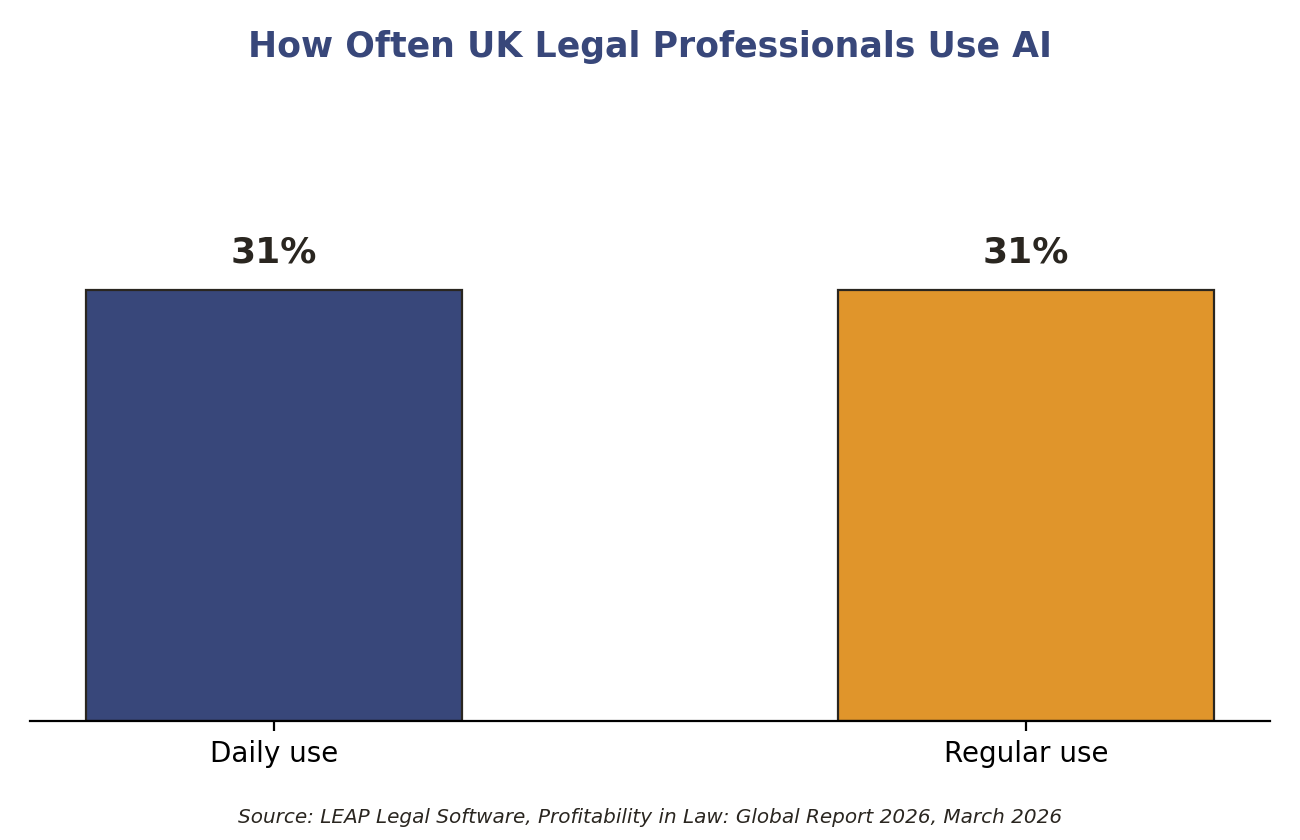
How often UK legal professionals use AI, daily versus regular use.
Source: Profitability in Law: Global Report 2026, LEAP Legal Software, March 2026 (survey of 700 legal professionals across six countries).
What Are the Practical Use Cases by Department?
The best examples of AI adoption tend to be specific to the department, not generic:
Corporate: due diligence review, clause comparison across contract versions, first drafts of routine agreements
Employment: summarising disciplinary case files, drafting and updating internal policies
Conveyancing: producing title summaries, extracting key terms from a lease
Litigation: building a chronology from case documents, supporting disclosure review
Private client: drafting estate summaries, preparing routine document sets
In each case, the tool produces a first attempt, but a qualified solicitor remains responsible for checking accuracy, legal relevance and tone before anything is sent.
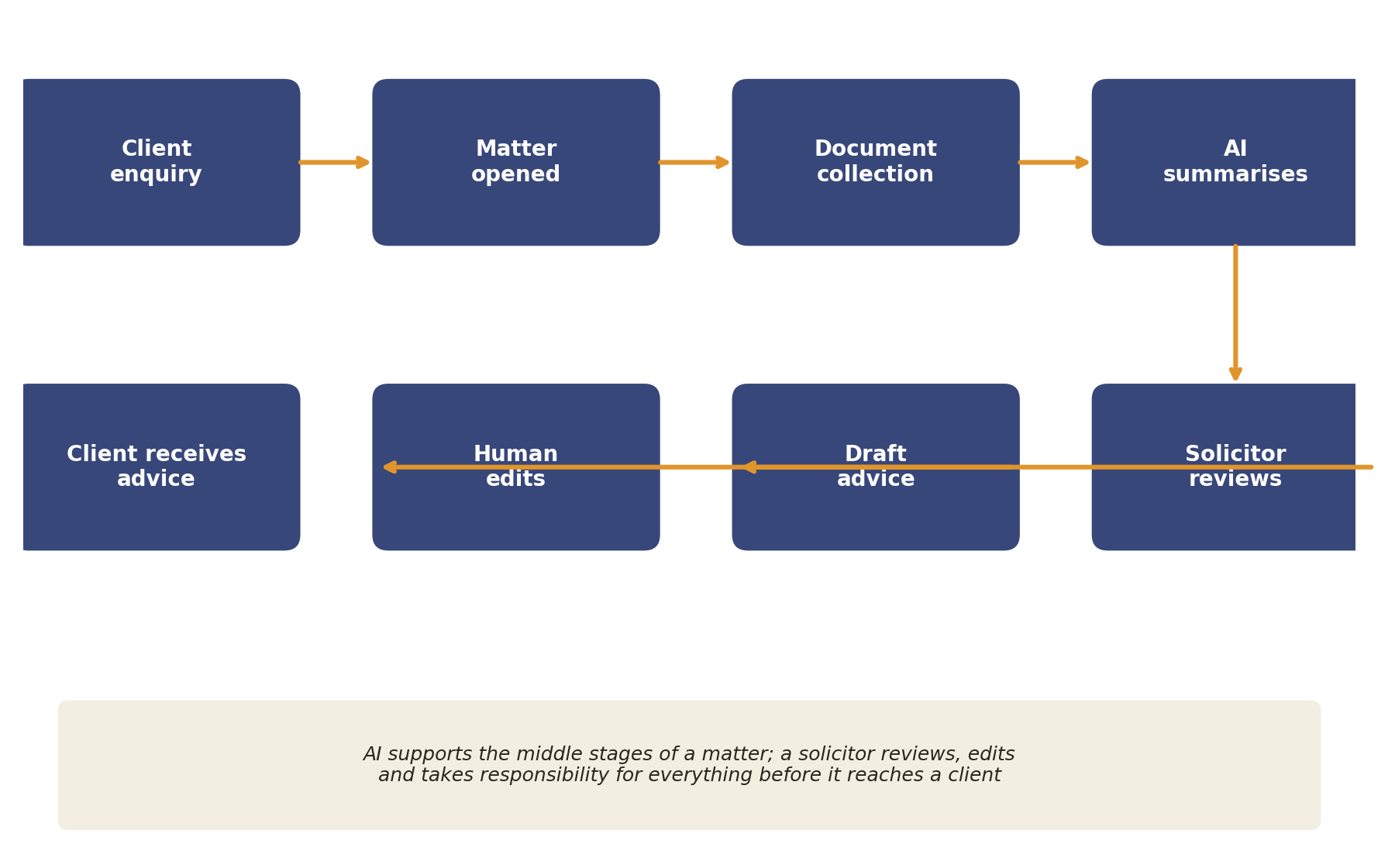
A typical AI-assisted matter, from client enquiry to advice being sent.
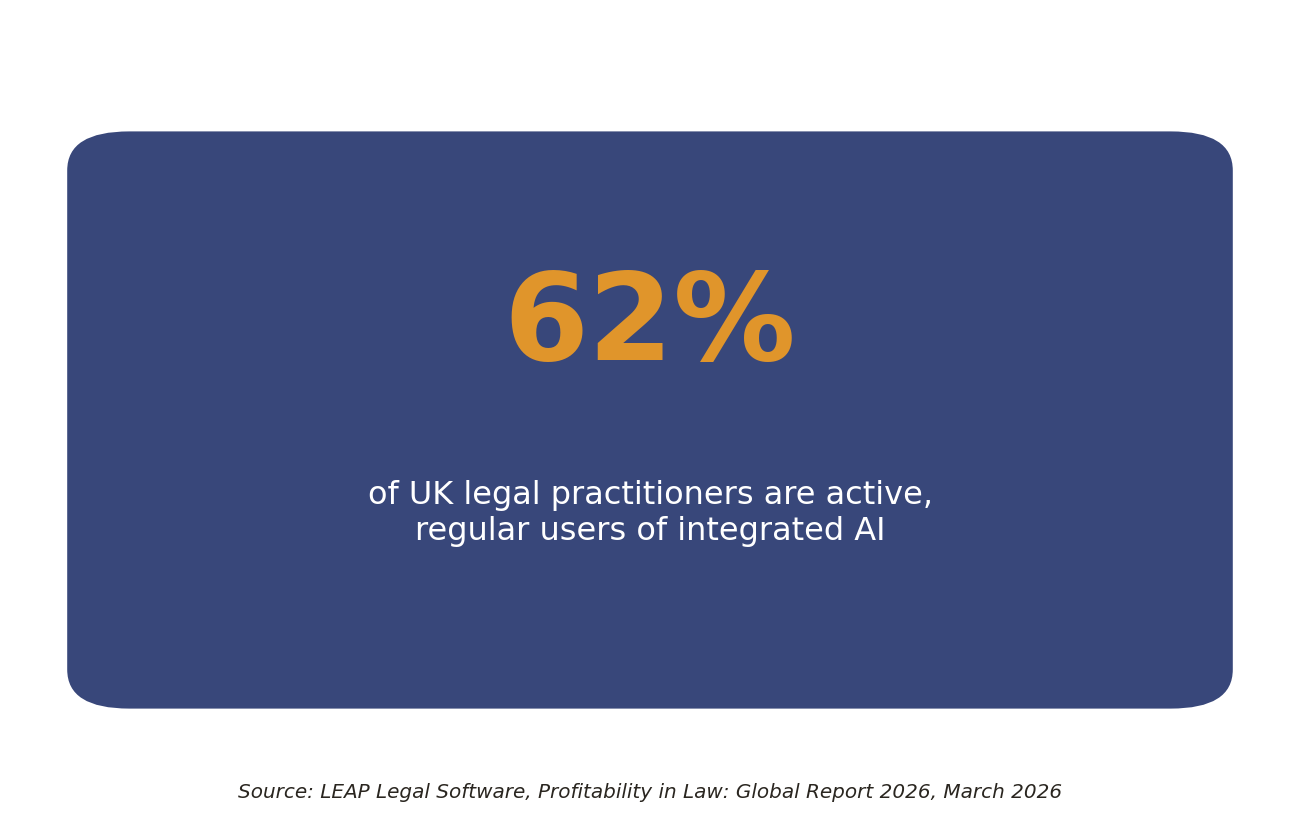
62% of UK legal practitioners surveyed reported regular, active use of integrated AI tools.
Source: Profitability in Law: Global Report 2026, LEAP Legal Software, March 2026 (survey of 700 legal professionals across six countries).
Which Tasks Are Lower Risk and Which Are Higher Risk?
Not every use carries the same level of risk, and it helps to think in terms of two rough categories. Lower-risk uses may include proofreading, formatting, internal summaries and meeting transcription, provided the material is suitable for the approved tool and confidentiality controls remain in place.
Higher-risk work includes legal advice, court submissions, case law citations, regulatory interpretation, client-specific recommendations and anything involving a decision about rights or liability. These need a higher level of human review before anything goes out the door, and some firms restrict them to specific approved tools only.
Meeting transcription: suitable for AI, low human review
Document summary: suitable for AI, medium human review
Contract review: suitable for AI, high human review
Legal advice: not suitable for AI, essential human review
Court submissions: not suitable for AI, essential human review
What Does the SRA Expect From Firms Using AI?
The Solicitors Regulation Authority has not created a separate rulebook exclusively for AI. Instead, firms are expected to apply existing duties of competence, supervision, confidentiality, accountability and professional judgement when using AI-assisted tools.
The SRA has also published guidance and risk material highlighting concerns including inaccurate outputs, confidentiality, bias, accountability and the risk of errors being repeated at scale. In practice, that means a solicitor needs to understand a tool well enough to review its output critically, including recognising when it might be wrong.
Source: Solicitors Regulation Authority, compliance tips for firms using AI
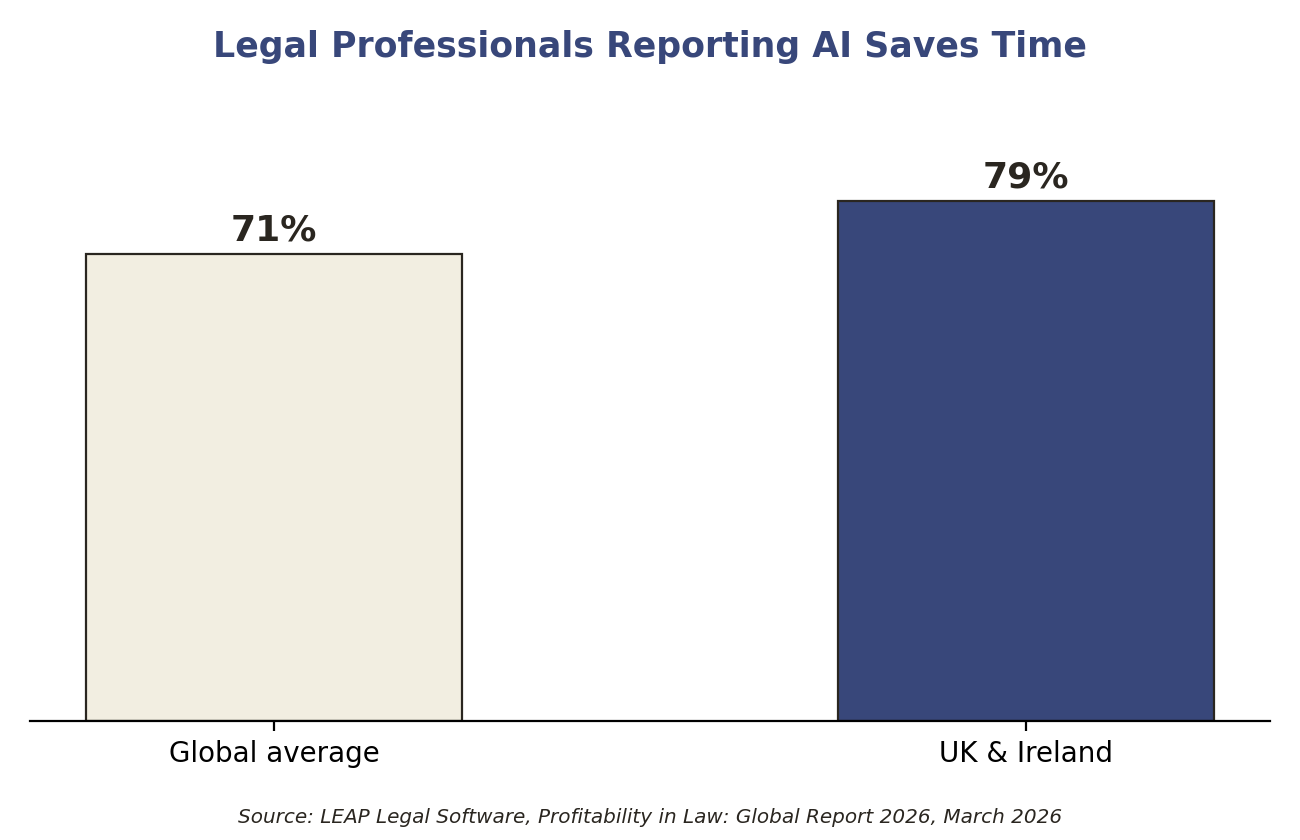
Legal professionals reporting AI saves time, UK and Ireland versus the global average.
Source: Profitability in Law: Global Report 2026, LEAP Legal Software, March 2026 (survey of 700 legal professionals across six countries).
How Does AI Help With Legal Research and Drafting?
AI can help identify potentially relevant authorities and summarise judgments faster than a manual search, which is useful early in a matter when the goal is simply to find a starting point. The same caution applies to drafting: a fluent first draft is not the same as a correct one, and the time saved at the drafting stage needs to be reinvested in careful review rather than skipped altogether.
Important: Never rely on an AI-generated case citation without checking the judgment or an authoritative legal database. A fluent answer can still be legally wrong. The Law Society's guidance on generative AI similarly stresses accuracy checks and human-led review before anything is relied upon.
Source: Law Society, generative AI essentials
Where Does AI Still Fall Short?
AI tools are useful but imperfect, and it helps to know where they tend to struggle. In practice, that includes hallucinating case citations that don't exist, misunderstanding factual nuance in a specific set of documents, missing recent judgments or legislative changes the model wasn't trained on, overlooking procedural context that a specific court or jurisdiction requires, and failing to appreciate commercial considerations that sit outside the strict legal question.
None of this makes the tools unusable. It's simply the reason a qualified person needs to stay in the loop on anything that leaves the firm.
Where Do Firms Typically Save Time?
The exact time saved depends heavily on the tool, the task and the firm, but the illustrative examples below give a sense of scale for common tasks. These are indicative ranges, not audited figures from a specific firm.
Contract summary: around 40 minutes manually, around 8 minutes with AI
Meeting notes: around 30 minutes manually, around 3 minutes with AI
Client update: around 20 minutes manually, around 5 minutes with AI
Chronology: around 2 hours manually, around 25 minutes with AI
Illustrative example only, not measured data from a specific firm.
What About Confidentiality, Privilege and Data Protection?
Before any client information goes into a third-party tool, it's worth getting clear answers to a specific set of questions: where is the data stored, are prompts retained, is data used to train the underlying model, what processor and subprocessor arrangements are in place, does data leave the UK, who has access, how long is information kept, are there audit logs, what does the contract say about confidentiality and breach notification, and does the tool support matter-level permissions so one client's data can't leak into another's context.
Firms should also identify the lawful basis for processing, minimise the personal data submitted, consider whether a data protection impact assessment is required, and decide how affected individuals will be given clear information about the use of AI.
Firms operating across the EU should assess whether the EU AI Act applies to their role as a provider, deployer or user of a particular system. The Act introduces risk-based and transparency obligations, but the exact requirements depend on how the technology is developed, supplied and used.
Sources: ICO, guidance on AI and data protection · European Commission, AI Act regulatory framework
Should Clients Be Told When AI Is Used?
Firms should decide when the use of AI is material enough to disclose to a client. Relevant factors may include whether client data is processed by a third party, whether the system contributes to substantive legal work, whether engagement terms cover the use of technology, and whether the use could affect confidentiality, cost or the client's expectations.
Depending on the use case, it is worth reviewing whether engagement letters need updating, whether consent is appropriate, how AI-assisted work is described in billing, whether outsourcing or subprocessing terms apply, and whether the use of AI has any bearing on professional indemnity cover.
Will AI Replace Solicitors?
AI is far more likely to change the way solicitors work than replace them. Routine administrative tasks will increasingly be automated, while client relationships, negotiation, advocacy, legal judgement and ethical decision-making will remain fundamentally human responsibilities. We've seen the same question asked about financial advisers, and the answer tends to be the same: AI changes the job before it changes the headcount.
What Questions Should You Ask an AI Vendor?
Beyond data handling, it's worth pressing a vendor on a few other points: what happens if the tool gets something wrong, what evidence exists that it performs well on legal-specific tasks rather than general text, how are updates to the underlying model communicated, and what support is available if something goes wrong on a live matter.
It's also worth asking whether the firm can opt out of model training, whether data can be deleted on request, what independent security certifications exist, whether the vendor can provide audit logs, what happens when the underlying model changes, whether professional indemnity or contractual liability is capped, and which subprocessors are used.
A vendor that can't answer these clearly is a warning sign, regardless of how polished the product demo looks. The same due-diligence questions come up in our guide to AI tools for consultants, another field where research and drafting quality both matter.
How Do You Create a Law Firm AI Policy?
A policy that actually gets followed tends to cover a specific list of points rather than general principles: which tools are approved and which are prohibited, permitted use cases, restrictions on client data, human review requirements, citation verification, confidentiality and privilege, record keeping, staff training, escalation procedures, incident reporting, vendor approval, and a schedule for periodic review.
Without this level of detail, staff tend to fall back on whatever consumer tool they already use at home, which is exactly the scenario a policy is meant to prevent.
What Records Should a Firm Keep?
For higher-risk uses, firms should keep enough information to show what tool was used, what instructions were given, what output was produced, who reviewed it, and what changes were made before the work was relied upon or sent to a client. That record should also capture the original instructions, any corrections made, final approval, and any incidents or failures worth learning from.
How Do You Run a Safe Pilot?
Starting with one lower-risk, measurable use case gives a firm real-world evidence before it commits to wider adoption. Document summarisation is often a practical pilot, provided confidential material is handled through an approved system. Track time saved, error rate and staff confidence over a few weeks, and involve the people who'll actually use the tool day to day rather than rolling out a decision made entirely at partner level.
Firms that expand slowly, one practice group or task at a time, tend to end up with more consistent adoption than those that mandate a tool firm-wide on day one.
AI Readiness Checklist for Law Firms
AI policy in place
Approved tools list
Human review process
Staff training completed
DPIA completed
Vendor security reviewed
Client engagement terms reviewed
Audit trail enabled
Frequently Asked Questions
Is ChatGPT safe for law firms?
General-purpose tools like ChatGPT aren't built with legal confidentiality or accuracy safeguards in mind. Firms should avoid entering client information into consumer-grade tools and use products designed for legal use, with clear data handling terms, instead.
Can solicitors use AI?
Yes. There is no rule against using AI in legal practice. Existing duties of competence, supervision and confidentiality apply to AI-assisted work the same way they apply to any other task.
Does the SRA allow AI?
The SRA has not banned or specifically restricted AI use. It expects firms to apply existing professional standards, understand the tools they use, and remain accountable for the output.
Can AI write legal contracts?
AI can produce a first draft of a contract or clause, but it shouldn't be treated as a finished, reliable document. A qualified solicitor needs to review, amend and take responsibility for anything that goes to a client.
Is AI confidential?
It depends on the tool. Some AI systems retain prompts or use them for model training, which can create confidentiality risks. Firms should check a vendor's data handling policy before entering any client information.
Should clients be told AI was used?
There's no blanket rule, but firms should consider disclosure when a system processes client data via a third party or contributes meaningfully to legal work, and update engagement terms accordingly.
Is AI-generated legal advice legally binding?
No. AI output is not legal advice on its own. Advice only becomes legal advice once a qualified solicitor has reviewed, taken responsibility for, and issued it to a client in the course of a retainer.
Can AI breach legal professional privilege?
It can, if privileged material is entered into a tool that stores, shares or trains on that data without appropriate safeguards. Firms should check a vendor's data handling terms before putting any privileged material near an AI system.
Key Takeaways
AI can improve speed and consistency, but it does not remove professional responsibility
Every AI-generated citation, legal proposition and client-facing draft should be checked
Confidentiality, privilege and data protection must be considered before client information is entered into any tool
Firms should approve specific tools and use cases rather than allowing unrestricted adoption
A written AI policy should cover supervision, data handling, record keeping and escalation
Starting with one low-risk, measurable pilot is safer than a firm-wide rollout
Ready to Explore AI Safely?
Whether you're experimenting with AI for the first time or looking to formalise its use across your firm, AI Workforce can help you identify suitable use cases, design secure workflows and introduce AI with appropriate safeguards. Book your AI Readiness Review to see where your firm could save time while maintaining professional standards.
About AI Workforce
AI Workforce helps UK organisations introduce AI safely through practical automation, AI agents and workflow design. We work with businesses to identify suitable use cases, improve productivity and implement AI with appropriate governance and human oversight.
Reviewed against SRA and ICO guidance: August 2026