AI Marketing Agents: How They Work, Use Cases and Risks
Posted On: July 29, 2026
Last updated: August 2026
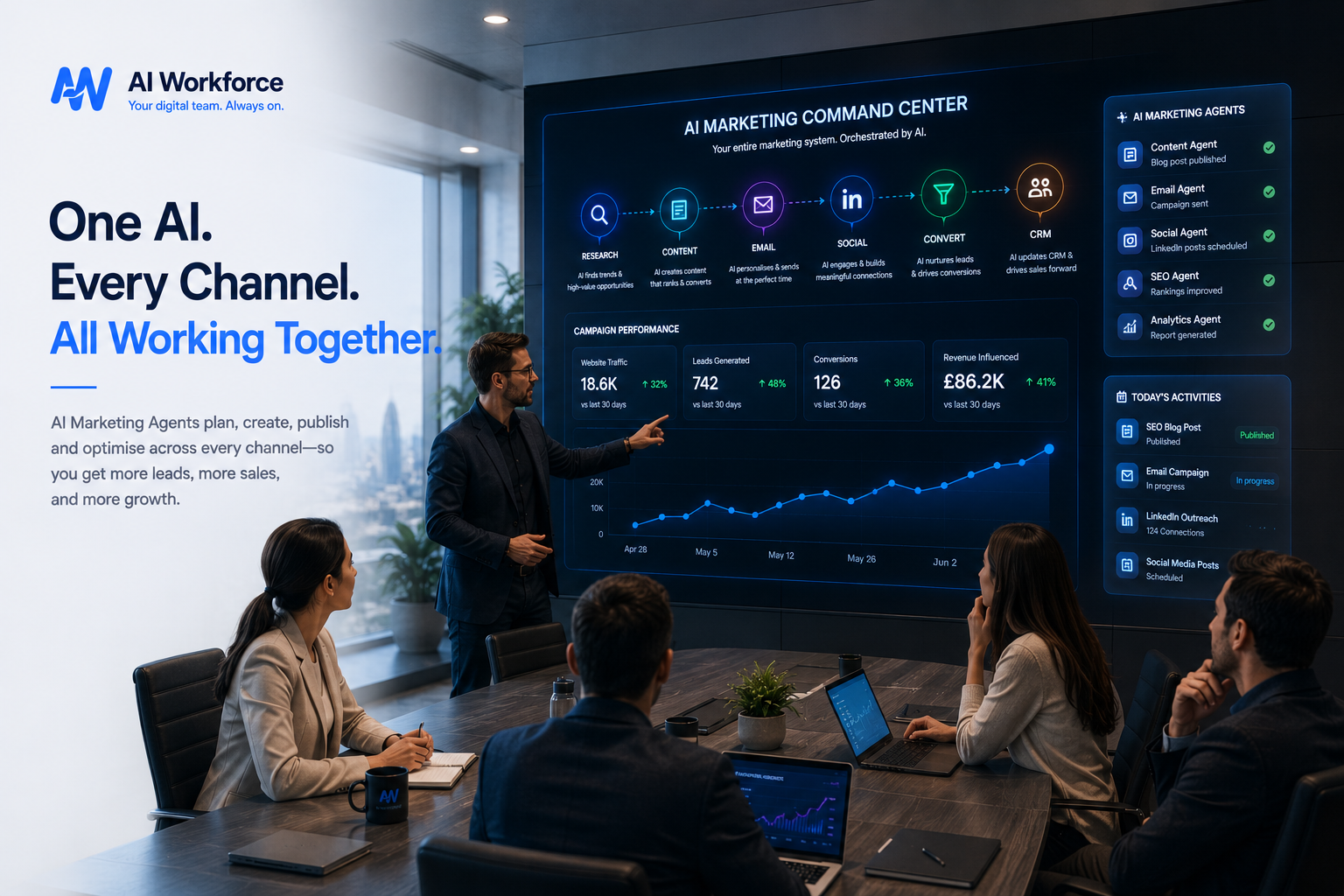
AI can now do much more than write a blog post or suggest an email subject line. Modern AI marketing agents can research, draft, analyse, route leads and coordinate work across multiple tools with limited human input. For many marketing teams, the question is no longer whether to use AI, but where agents can add value without introducing unnecessary risk. Adoption of these tools is real, but so is a wide gap between businesses experimenting with AI and those getting measurable value from it. Adoption does not necessarily mean maturity: many organisations are still experimenting with agent-based workflows and have not yet achieved measurable commercial returns. This article explains what marketing agents actually are, where they fit today, and the questions worth asking before you rely on one.
Quick answer: An AI marketing agent is software that can carry out a multi-step marketing task with limited human input, such as drafting a campaign brief, pulling a reporting summary or triaging leads. Unlike a chatbot, it can act across several steps and tools on its own. Many teams begin by testing agents on lower-risk tasks such as research, drafting and reporting, with a person reviewing the output before it reaches a customer.
What Is an AI Marketing Agent?
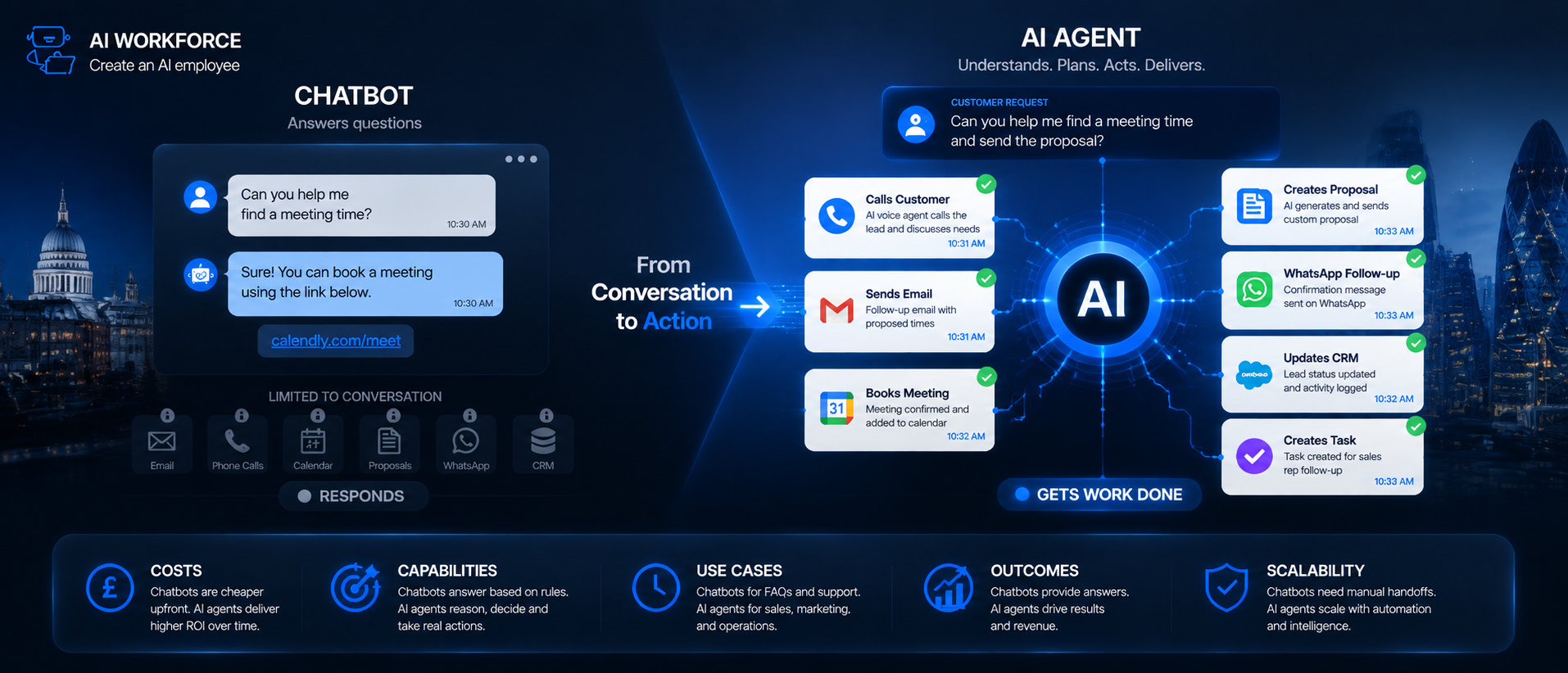
A marketing agent is built on a large language model but wrapped with extra capabilities: it can hold context over several steps, call other tools or systems, and decide the order of its own actions within limits a person sets. A basic chatbot answers one prompt at a time. An agent might take a single instruction ("prepare next week's newsletter draft"), pull relevant data, draft the content, and flag it for review, without a person prompting each step individually.
That said, "agent" is used loosely across the industry right now, and vendors apply the term to tools with very different levels of autonomy. Some products marketed as agents are closer to well-built automations with an AI step inserted. It's worth asking any vendor exactly what decisions their tool makes on its own, and what it always hands back to a person.
In our experience working with businesses introducing AI workflows, the quickest wins usually come from reporting, content repurposing and lead qualification rather than attempting to automate entire campaigns. These workflows are repetitive, measurable and easier to supervise, making them good candidates for an initial pilot.
Agent vs Chatbot vs Rules-Based Automation
These three are often confused, and the differences matter when you're deciding what to trust with a task.
Rules-based automation: follows a fixed, pre-built path (if X happens, do Y). Reliable and predictable, but can't adapt if a step doesn't go as expected.
AI chatbot: responds to a single prompt at a time. Useful for drafting or answering questions, but has no memory of a broader task and doesn't take action beyond generating text.
AI marketing agent: can hold a goal across multiple steps, decide which tool or data source to use, and carry out a short sequence of actions with limited human input at each step, though a person typically still sets the goal and reviews the result.
The practical difference is autonomy, not intelligence. An agent isn't necessarily "smarter" than a chatbot: it's simply been given permission to act across more steps before coming back to a person.
Follows fixed steps: automation yes, chatbot no, agent sometimes
Responds to prompts: automation limited, chatbot yes, agent yes
Acts across multiple tools: automation limited, chatbot usually no, agent yes
Adapts within boundaries: automation no, chatbot limited, agent yes
Runs multi-step tasks: automation yes if predefined, chatbot no, agent yes
Best used for: automation handles predictable processes, chatbots handle drafting and questions, agents handle variable workflows
How an AI Marketing Agent Works
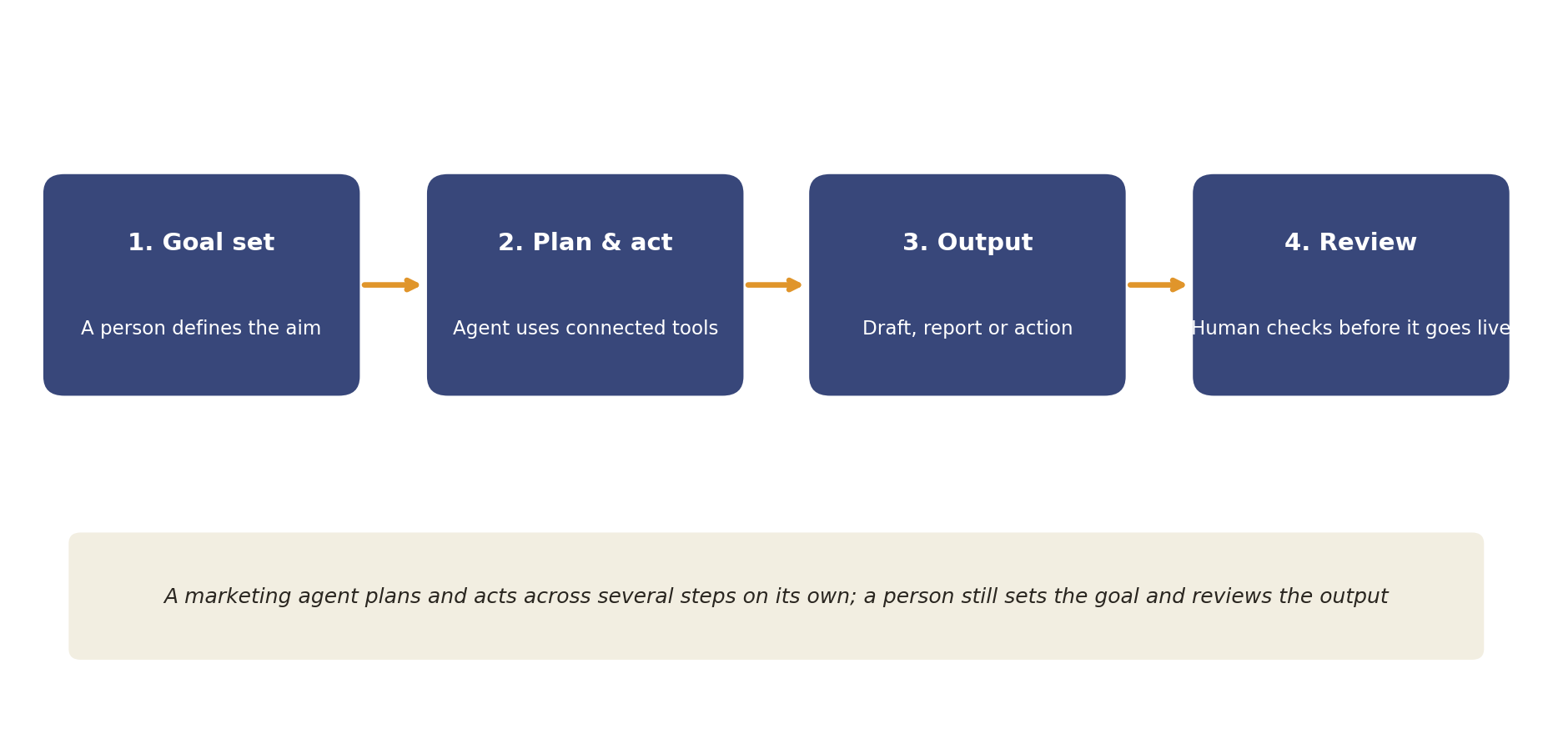
A marketing agent plans and acts across several steps, with a person setting the goal and reviewing the output.
A typical agent workflow has four stages: a person sets the goal, the agent plans and acts using whatever tools it has access to, it produces an output, and a person reviews that output before it goes any further. The review step matters. Removing it entirely is where most of the real risk in agentic marketing tools sits, and it's the point most UK teams are still choosing to keep firmly in human hands.
Common Types of Marketing Agents
Vendors group agent capabilities differently, but most fall into a handful of recognisable categories:
Content creation agents: draft blog posts, ad copy or social captions from a brief, often learning a brand's tone over time.
Campaign planning agents: help build out campaign structure, audience segments and scheduling from a set of goals.
Reporting and analytics agents: pull performance data from connected platforms and summarise it into a readable update.
Lead-nurture agents: score incoming leads and trigger the next appropriate follow-up step.
Email marketing agents: draft and sequence email content, and adjust send timing based on engagement signals.
Social media agents: draft, schedule and sometimes respond to routine comments across social channels.
SEO agents: research keywords, draft on-page recommendations or summarise search performance.
Customer research agents: summarise reviews, survey responses or support tickets into themes.
Marketing operations agents: keep CRM records, tags or campaign data tidy and consistent.
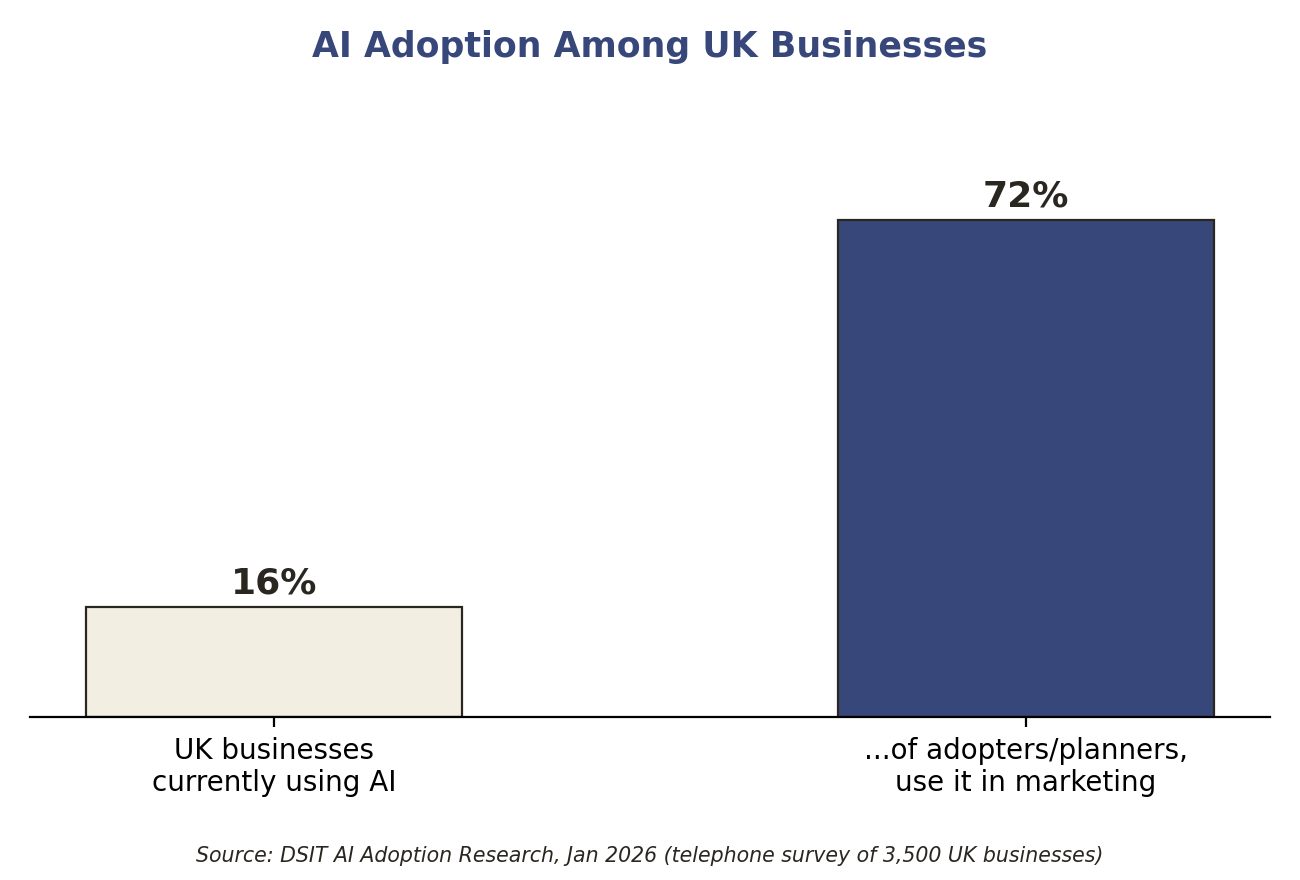
AI adoption among UK businesses, and the share of adopters or planners using it in marketing.
Source: DSIT, AI Adoption Research (ref DSIT 2026/003), published 28 January 2026. Telephone survey of 3,500 UK private-sector businesses with 5+ employees, conducted by IFF Research and Technopolis Group, February–May 2025. "AI adoption" is defined as currently using at least one of five AI technology categories.
Practical Workflows
Three examples of how these agents are used together in practice.
Content workflow: Brief drafted by marketer → agent researches topic and competitor content → agent drafts article → marketer edits and adds original insight → agent formats for CMS → human approves and publishes.
Campaign reporting workflow: Agent pulls data from ad platforms and CRM → agent drafts a plain-language summary of performance → agent flags any metric outside a set range → marketer reviews and adds commentary → report sent to stakeholders.
Lead-nurture workflow: Lead submits a form → agent scores the lead against set criteria → agent selects the next relevant email or task → sales rep is notified for higher-value leads → agent logs the interaction in the CRM. The scoring criteria should be documented and reviewed for unfair or irrelevant proxies, particularly where personal or inferred data is involved.
In each case, the agent handles the repetitive middle steps. A person still sets the brief, reviews the output, and makes the final call before anything reaches a customer.
Lower-Risk and Higher-Risk Tasks
Not every marketing task is equally safe to hand to an agent. It's worth being deliberate about where autonomy is appropriate.
Generally lower-risk: first-draft content generation, internal reporting summaries, keyword or topic research, tagging and CRM tidy-up, scheduling routine social posts for review
Higher-risk, needs closer oversight: anything sent directly to a customer without review, pricing or discount decisions, claims about product performance or results, personal data handling and email/SMS sequencing, and any public-facing content published without a human check
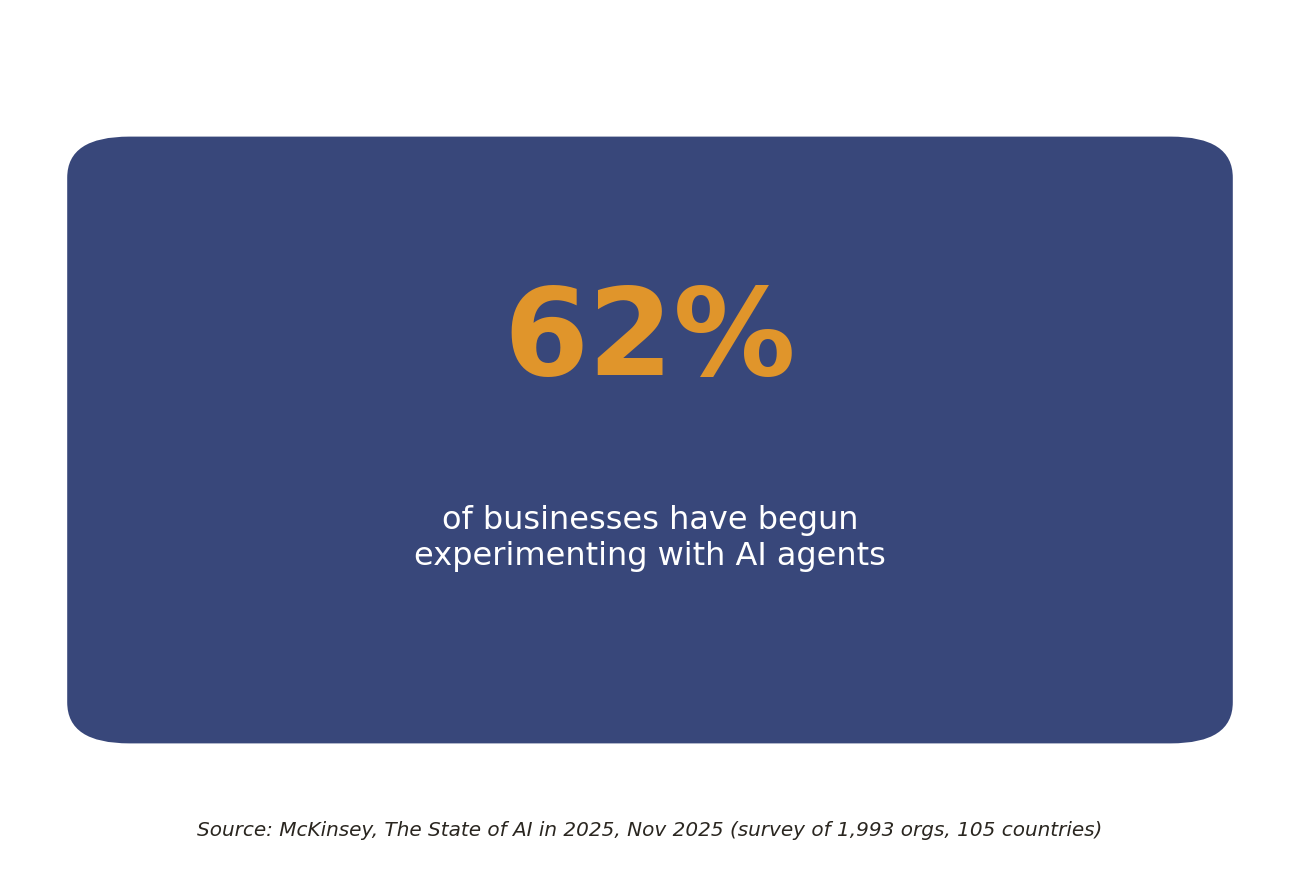
62% of businesses report their organisation is at least experimenting with AI agents (23% scaling, a further 39% experimenting).
Source: McKinsey, The State of AI in 2025: Agents, Innovation, and Transformation, November 2025 (online survey of 1,993 respondents in 105 countries, fielded June–July 2025).
A Practical Maturity Model for Marketing Agents
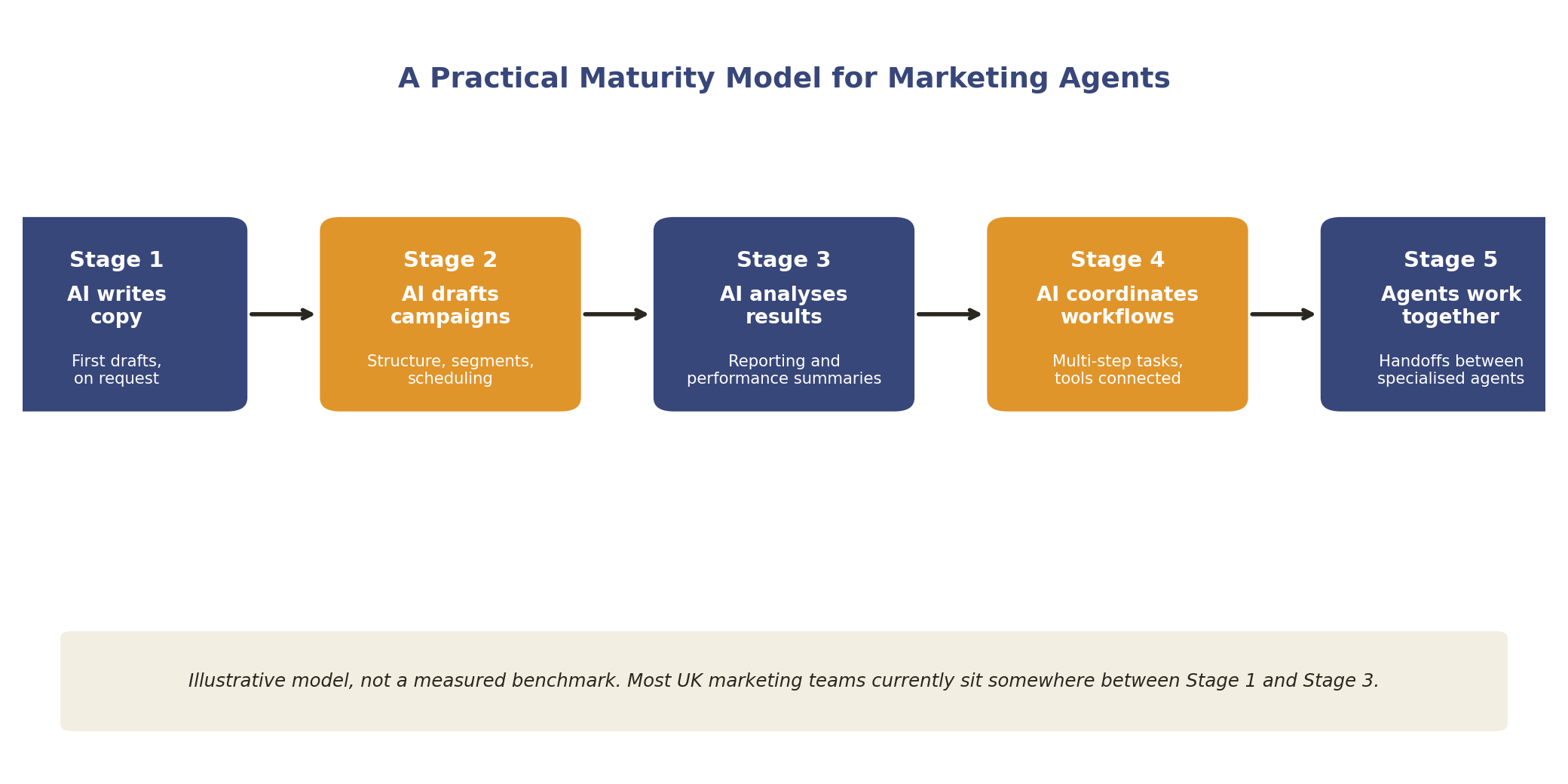
Most UK marketing teams currently sit somewhere between Stage 1 and Stage 3.
Most teams don't jump straight to fully autonomous agents. Adoption tends to follow a rough progression: Stage 1, AI writes copy on request; Stage 2, AI drafts full campaigns, including structure, segments and scheduling; Stage 3, AI analyses results and produces reporting summaries; Stage 4, AI coordinates multi-step workflows across connected tools; Stage 5, multiple specialised agents hand work between each other with limited human input at each step. This is an illustrative model rather than a measured benchmark.
How Agents Use Data and Tools
Most marketing agents work by connecting to existing systems: your CRM, ad platforms, email tool, analytics dashboard or content management system. The agent reads from these tools, and in some cases writes back to them (updating a CRM field, scheduling a post, sending an email). This is where the practical risk lives: an agent with write access to your CRM or your customers' inboxes can make changes at a scale a person couldn't easily do by hand, so the access it's given should be scoped deliberately rather than left wide open by default.
Platforms and Selection Criteria
The market includes both large platforms adding agent features to existing marketing suites, and smaller specialist tools built around a single workflow.
HubSpot: best for CRM-first marketing teams already on the platform
Salesforce Marketing Cloud: best for enterprise teams with complex, multi-channel campaigns
Relevance AI: best for custom, configurable, workflow-specific agents
Jasper: best for high-volume content production
Adobe: best for creative teams producing visual and video assets
For a broader look at how agencies themselves are using these tools, see our guide to the best AI marketing agencies for 2026.
CRM-native agent platform: best for teams already using the same CRM; main consideration is ecosystem dependence
Configurable agent builder: best for custom multi-step workflows; main consideration is more setup and governance
Content-focused platform: best for high-volume creative production; main consideration is editorial review
Bespoke agent system: best for unique workflows and data; main consideration is implementation cost
When comparing platforms, questions worth asking include: what data does the agent need access to, and can that be limited? Does it keep a log of the actions it takes? Can a person review output before it's published or sent? Where is data processed and stored, and does that affect UK GDPR compliance? What happens when the agent gets something wrong, who is notified, and how is it corrected?
Governance and Brand-Risk Controls
Before rolling out any marketing agent, a few controls are worth having in place:
A clear, written policy on which tasks agents can complete without review and which always need a human check
Defined ownership: someone named as responsible for what an agent publishes or sends under your brand
An access review, so agents only have the permissions and data access a task genuinely requires
A logging or audit trail so actions taken by an agent can be reviewed after the fact
A process for catching and correcting mistakes quickly, including a way to pause or disable an agent if something goes wrong
Budget caps, audience exclusions and suppression lists enforced at system level rather than left only in written instructions, for any agent that can adjust ad spend or contact customers
Data Protection and Privacy (UK GDPR and PECR)
Marketing agents that handle customer data, especially anything used for email or SMS marketing, fall under UK GDPR and the Privacy and Electronic Communications Regulations (PECR). If an agent is scoring leads, personalising content using personal data, or triggering marketing messages, that counts as processing personal data, and the usual obligations apply: a lawful basis for the processing, data minimisation, and clarity for customers about how their data is used. PECR rules governing marketing emails and texts apply regardless of whether the message is sent by a person or an agent; the applicable consent and opt-out requirements depend on the recipient, channel and circumstances. It's worth checking with whoever handles data protection at your organisation before giving an agent access to customer data, and the ICO's guidance on AI and data protection is a useful starting point.
How to Run a Pilot
Most teams get more value from starting narrow. A sensible pilot looks like: pick one well-defined, lower-risk task (drafting reporting summaries is a common starting point), give the agent access to only the data it needs for that task, keep a human review step in place, run it for a few weeks, and compare the output and time saved against doing the task manually before expanding to anything higher-risk.
How to Measure Results
Useful measures for an agent pilot include time saved on the task per week, the proportion of outputs that needed significant human editing before use, error or correction rate, and, where relevant, downstream metrics like response rate or lead quality.
Illustrative scenario, not measured data: a weekly report that takes one team around two to three hours manually might fall to 30–45 minutes of review time after the collection and first draft are automated. Actual savings depend on the number of channels, data quality and reporting requirements, and will vary by team.
Beyond reporting, teams typically see a similar shift in effort across a handful of other repetitive tasks:
Weekly reporting: high manual effort → review only
Blog and content repurposing: several manual drafts → one review pass
CRM tidy-up: manual field-by-field updates → automated checks with spot review
Lead routing: individual manual review → rules plus AI scoring, with human sign-off on higher-value leads
Illustrative shifts in effort, not measured figures. Actual results will vary by team and data quality.
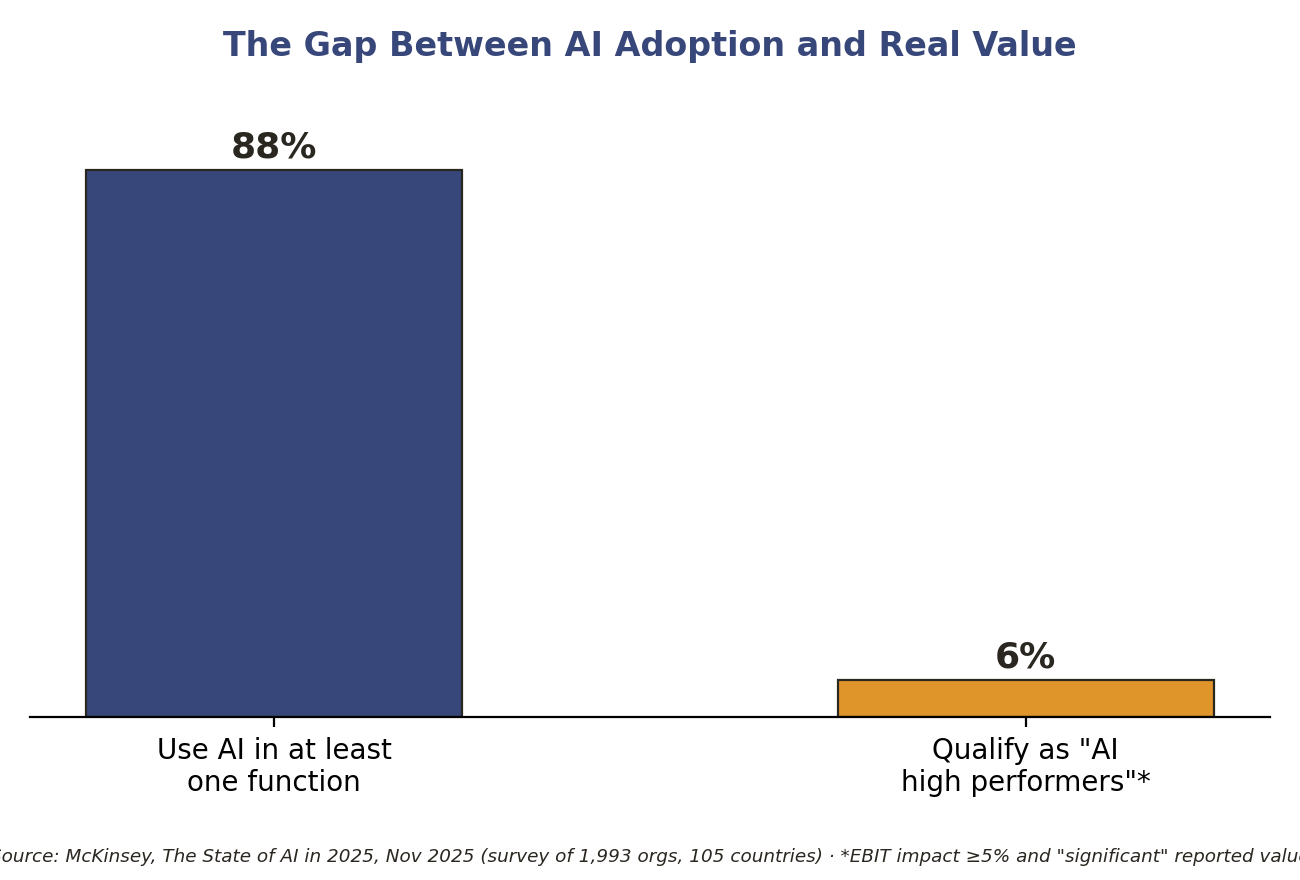
The gap between businesses using AI and those qualifying as "AI high performers" with measurable bottom-line impact.
Source: McKinsey, The State of AI in 2025: Agents, Innovation, and Transformation, November 2025 (online survey of 1,993 respondents in 105 countries, fielded June–July 2025). "High performers" defined as respondents reporting 5%+ EBIT impact and "significant" value from AI.
Where Agents Still Fall Short
Agents are not reliably good at tasks that require genuine judgement, up-to-date factual accuracy without verification, or an understanding of brand nuance that hasn't been explicitly defined. Some vendors claim a custom-trained agent will outperform a generic one; this is plausible for narrow, well-defined tasks with good training data, but it isn't a given, and depends heavily on the quality and volume of data used to configure it. Content still needs a human check for accuracy, tone and compliance before anything goes out under your brand.
Where Marketing Agents Fail in Practice
Beyond the technology's inherent limits, most real-world agent failures trace back to a handful of avoidable setup problems:
Poor CRM data: an agent making decisions on incomplete or outdated records will make confidently wrong ones
Unclear brand guidelines: without a documented tone and set of rules, an agent has nothing consistent to work from
Conflicting instructions: different team members giving an agent contradictory goals produces unpredictable output
A weak approval process: if review is informal or inconsistent, mistakes reach customers before anyone catches them
No named owner: without someone accountable for an agent's output, small issues go unaddressed until they're bigger ones
Too much autonomy too early: expanding an agent's access before its output has been tested at a smaller scale
Common mistakes to avoid: giving an agent unrestricted CRM access, publishing customer-facing content without review, expecting AI to fix poor-quality marketing data on its own, and measuring activity (posts published, emails sent) instead of business outcomes.
Frequently Asked Questions
Is an AI marketing agent the same as a chatbot?
No. A chatbot responds to one prompt at a time. An agent can hold a goal across multiple steps and take a short sequence of actions, though a person typically still sets the goal and reviews the result.
What's the difference between AI automation and an AI agent?
Automation follows a fixed, pre-built path: if X happens, do Y, with no ability to adapt when a step doesn't go as expected. An agent can decide which tool or data source to use and adapt its actions within set boundaries, making it better suited to variable, multi-step workflows.
Do I need technical skills to use a marketing agent?
Many commercial platforms provide no-code interfaces, but reliable deployment may still require support with integrations, permissions, data structure, testing and governance.
What data protection rules apply to marketing agents?
UK GDPR and PECR apply to any agent handling personal data or sending marketing messages, in the same way they'd apply to a person doing that work.
Can an agent send emails or publish content without review?
Technically, yes, most platforms allow this. Whether it's a good idea depends on the risk of the task; many teams keep a human review step for anything customer-facing.
How much does a marketing agent cost?
Pricing varies widely by platform and usage, from add-ons within existing marketing suites to standalone subscriptions. It's worth checking pricing directly with each vendor.
Will an AI agent replace marketing staff?
Most current use cases support existing marketing work rather than replace it, handling repetitive steps so people can focus on strategy, judgement calls and final review.
What's the biggest risk with marketing agents?
Giving an agent too much unreviewed access, particularly to customer-facing communication or personal data, before governance and oversight are in place.
How do I know if a task is safe to hand to an agent?
As a general guide, tasks that are repetitive, lower-stakes and easy to review quickly (drafting, research, internal reporting) are safer starting points than anything customer-facing, financial or compliance-sensitive.
Are AI marketing agents suitable for small businesses?
They can be, particularly for repetitive tasks such as reporting, content repurposing and lead administration. Small businesses should begin with a narrow use case and avoid giving an agent broad access before its output has been tested.
Can an AI agent manage advertising budgets?
Some systems can adjust bids and budgets, but this is a higher-risk use. Firms should apply spending caps, approval thresholds, audit logs and alerts before allowing automated changes.
Key Takeaways
An AI marketing agent can plan and act across multiple steps, unlike a single-prompt chatbot
Many teams are using agents for lower-risk tasks: drafting, research and reporting, with a human review step kept in place
AI adoption is high, but the gap between adoption and measurable value remains wide industry-wide
UK GDPR and PECR apply in full to any agent handling personal data or sending marketing messages
Start with a narrow, well-scoped pilot on a lower-risk task before expanding an agent's access or autonomy
Governance (clear ownership, access limits and an audit trail) matters as much as the technology itself
Ready to Explore AI Marketing Agents Safely?
AI Workforce helps UK businesses identify suitable marketing workflows, connect agents to existing systems and introduce practical controls for data, brand approval and human oversight. Start with one measurable workflow and expand only after the results are reliable.
About AI Workforce
AI Workforce helps UK organisations introduce AI safely through practical automation, AI agents and workflow design. We work with businesses to identify suitable use cases, improve productivity and implement AI with appropriate governance and human oversight.
Reviewed against current UK GDPR and PECR guidance: August 2026