AI Sales Meeting Automation: How AI Agents Book More Meetings
Posted On: July 7, 2026
Last updated: August 2026 · Written by Seth Ayush, Co-Founder of AI Workforce
Booking a sales meeting used to mean emails going back and forth, missed replies, and reps losing hours every week to get one call on the calendar. AI agents can now read a reply, check calendars, qualify the lead and book the meeting without a person carrying out each step. This guide explains how that actually works, what it costs, where it can go wrong, and how to decide if it fits your sales team.
Quick Answer: AI sales meeting automation uses AI agents to handle the manual work around booking a sales call: reading a lead's reply, checking calendar availability, sending an invite, qualifying the lead against defined criteria, and preparing a summary before the rep joins the call. It does not replace the sales conversation itself. It removes the admin that sits around it, so reps spend more time in conversations and less time on scheduling and research.
At a Glance
What it is: AI agents that handle meeting booking, lead qualification, meeting prep and follow-up around a sales call
Best suited to: teams with meaningful reply and meeting volume, where scheduling admin is eating into selling time
Typical cost: a defined scheduling and qualification workflow commonly costs £3,000 to £10,000 to build, with £200 to £800 a month in ongoing costs
Biggest benefit: faster response to replies, fewer missed follow-ups, and reps walking into calls already briefed
Biggest risk: an agent misreading intent, over-filtering leads, or booking a meeting with someone who does not actually fit
What's Covered
What Is AI Sales Meeting Automation?
How Does an AI Agent Book a Meeting?
Traditional Scheduling vs AI Meeting Automation
Who This Is For
How AI Agents Qualify Leads Before a Meeting
How AI Improves Meeting Prep
What Happens After the Meeting Is Booked?
What This Costs
Where AI Scheduling Can Go Wrong
Governance and Data Considerations
What to Look for in an AI Sales Platform
Choosing the Right Setup for Your Sales Team
How to Measure Whether It's Working
FAQs
Key Takeaways
What Is AI Sales Meeting Automation?
AI sales meeting automation is the use of AI to handle the manual work involved in booking, qualifying, and preparing for a sales meeting. Instead of a rep manually checking availability, sending calendar invites and digging through notes beforehand, an AI agent reads the lead's reply, finds a time that works for both sides, and sends the invite without a person carrying out each step. A basic scheduling link cannot do this well on its own, since it has no sense of context or priority, only open slots.
This matters because a meaningful part of the work around booking a sales call is repetitive: checking calendars, sending confirmations, chasing a reply. That kind of task does not need judgement, just consistency, and consistency is where AI agents tend to perform well. Many teams use AI scheduling to reduce response delays and remove friction from booking, although the actual result depends on the workflow, the audience and the quality of the implementation, not something that follows automatically from switching the tool on.
How Does an AI Agent Book a Meeting?
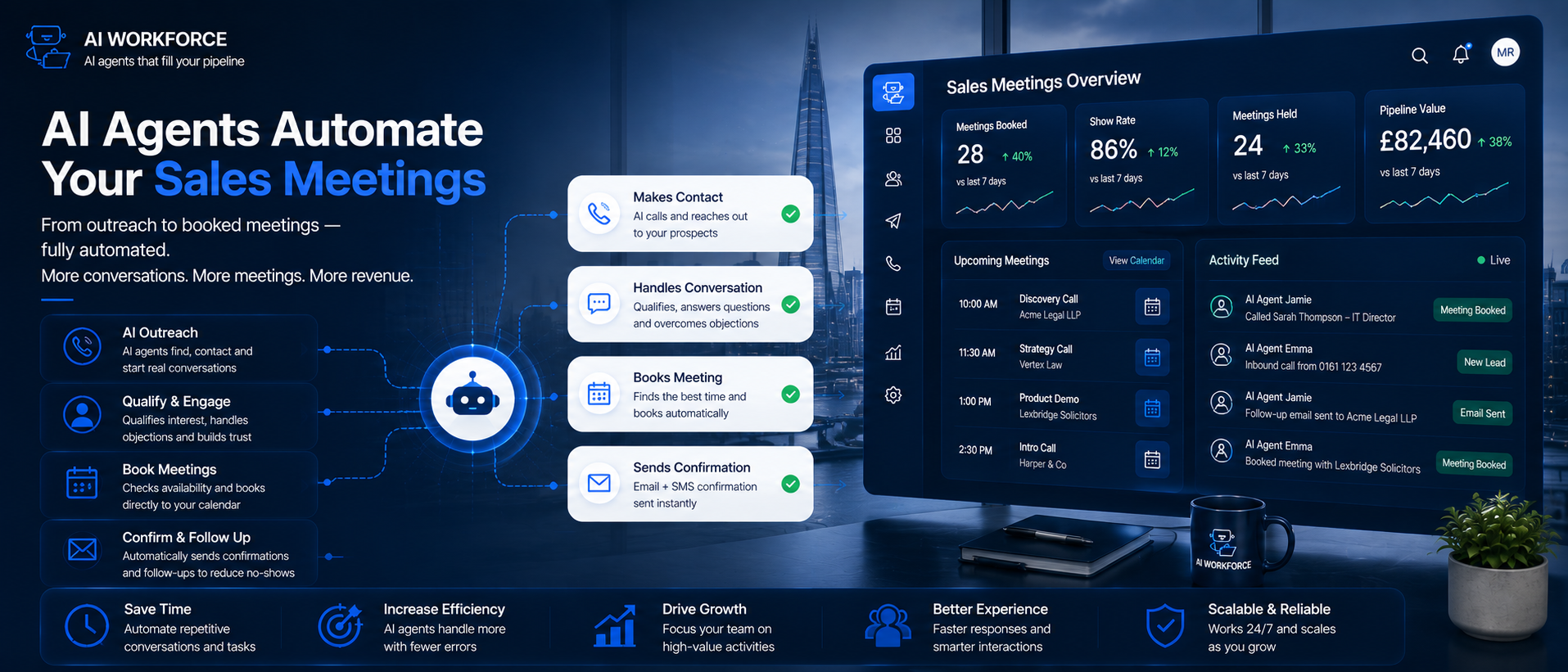
An AI scheduling agent typically connects to a calendar, a CRM, and the email or chat channel where the conversation is happening. When a lead replies to an outreach message or an enquiry, the agent reads the reply, works out whether the person wants to book a call, and offers times that fit both sides. Once the lead picks a time, the agent confirms the booking and sends the relevant details.
Behind this sits a model trained to recognise common types of reply: a request to reschedule, a question about pricing, a request for more information before committing to a call. The agent responds appropriately to each, in a similar way to how a trained rep would, though instantly and without being limited to office hours.
At AI Workforce, our agents are built to fit into a connected sales workflow, generating and qualifying leads, then handling the scheduling and prep work covered in this guide, so a business can move from finding a prospect to a booked, qualified conversation with less manual handling at each step.
The difference tends to show up most clearly outside normal working hours. A lead who replies at nine in the evening usually waits until the next morning to hear back from a person. An AI agent can respond while the lead is still engaged, rather than after the moment has passed, provided a person still reviews how the agent is handling replies during the early stages of a rollout.
A typical automated meeting booking workflow looks roughly like this:
A lead replies to an earlier message or submits an enquiry
The agent reads the reply and works out whether it signals interest in a call
The agent checks the reply against basic qualification criteria
The agent checks calendar availability for the relevant rep
The agent offers suitable times and confirms the booking once one is chosen
Confirmation details and reminders are sent automatically
A short meeting prep summary is compiled from CRM and conversation history
The rep joins the call already briefed
Notes and outcomes are logged back to the CRM after the call
A follow-up step is triggered if the meeting does not progress immediately
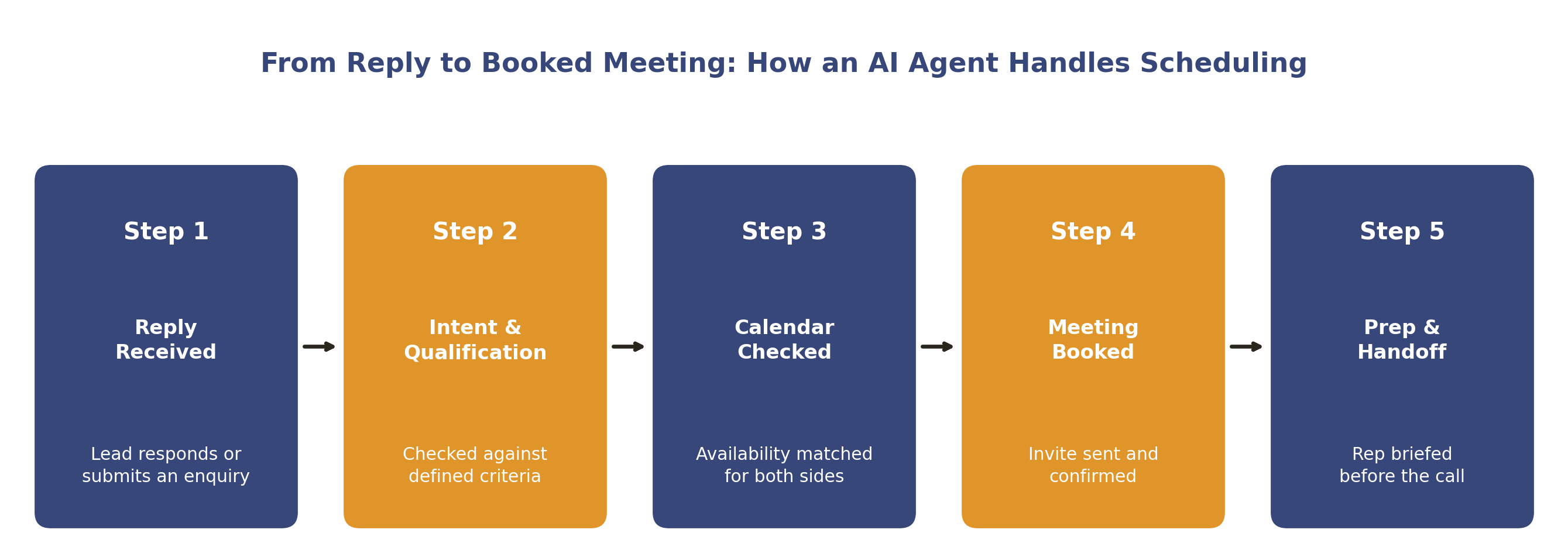
Illustrative workflow. A production system also needs monitoring, logging and a tested escalation path around these steps.
Traditional Scheduling vs AI Meeting Automation
"AI meeting booking" gets compared against two quite different things, and it helps to separate them. A basic scheduling link solves one part of the problem: it shows availability and lets someone pick a time. It has no sense of context, cannot read intent from a reply, and cannot qualify a lead or prepare a rep for the call. Manual scheduling by a rep solves the whole problem, but is slow and inconsistent once reply volume grows. AI meeting automation sits between the two, handling the full sequence without a person doing it by hand or a lead simply picking a slot with no context behind it.
Reading replies and understanding intent: a rep has to read every message manually; a scheduling link cannot do this at all; an AI agent handles it automatically
Checking calendar availability: a rep checks and replies manually; a scheduling link shows it automatically but with no context; an AI agent checks it as part of the same flow
Qualifying the lead: a rep applies their own judgement, which varies person to person; a scheduling link does not qualify at all; an AI agent applies the same defined criteria every time
Meeting prep: a rep researches the account before the call; a scheduling link provides none; an AI agent compiles a summary automatically
CRM updates: a rep's updates are often delayed or inconsistent; a scheduling link does not touch the CRM; an AI agent logs actions as they happen
Who This Is For
This kind of automation tends to add the most value for businesses with a meaningful, regular flow of inbound replies or enquiries, where scheduling and prep are eating into time that could go toward selling. It is a weaker fit for very low volume, highly bespoke sales processes where every conversation is genuinely unique.
Businesses that commonly see a good fit include:
SaaS and software companies with a steady flow of inbound demo requests
Recruitment agencies coordinating interviews across multiple candidates and clients
Estate agents and property businesses booking viewings and valuation calls
Professional services firms, such as accountants or consultancies, managing initial enquiry calls
Accountancy practices, where an agent can respond to new enquiries, ask a few qualifying questions about business size or needs, and book an initial consultation
Law firms and solicitors' practices, where an agent can gather basic case details from an enquiry before booking a consultation, leaving the substantive advice to a person
Construction and trades businesses, where an agent can respond to quote requests, gather project details, and schedule a site visit
B2B companies running outbound sales development with meaningful reply volume
How AI Agents Qualify Leads Before a Meeting
Before a meeting is booked, an AI agent can qualify a lead by asking a short set of questions, checking basic fit against your criteria, and only pushing genuinely relevant leads through to a rep's calendar. This matters because it reduces the number of meetings a rep attends with someone who was never a realistic fit, freeing up time for conversations that are more likely to progress.
Qualification criteria need to be set deliberately rather than left to the model's own judgement. A narrow, clearly defined set of questions tends to work better than an open-ended assessment, both because it is easier to test and because it gives the rep a consistent basis for understanding why a lead was passed through.
Reviewing which qualifying questions actually correlate with a closed deal, over time, is worth doing periodically. Criteria that made sense at launch can stop reflecting what a good-fit lead actually looks like as your product or market changes.
How AI Improves Meeting Prep
Meeting prep is where a lot of reps lose time before a call, checking notes, past emails and CRM fields to piece together context. An AI agent can pull that together automatically: a short summary of the lead's history, their company, and any relevant context from previous interactions, so the rep starts the call already briefed rather than reconstructing the picture live.
Better prep tends to change how the meeting itself goes. When a rep already understands a lead's likely pain points and prior interactions, the call can move straight into a genuine conversation rather than starting with discovery questions the lead may have already answered elsewhere. That can shorten the overall sales cycle to some degree, though the effect will vary by deal type and how much context was actually missing beforehand.
AI Workforce Insight: In our experience, the summaries that help most are short and specific, a few lines on what the lead has said and done, not a long transcript. Reps skim a wall of text before a call. A tight, relevant summary actually gets read.
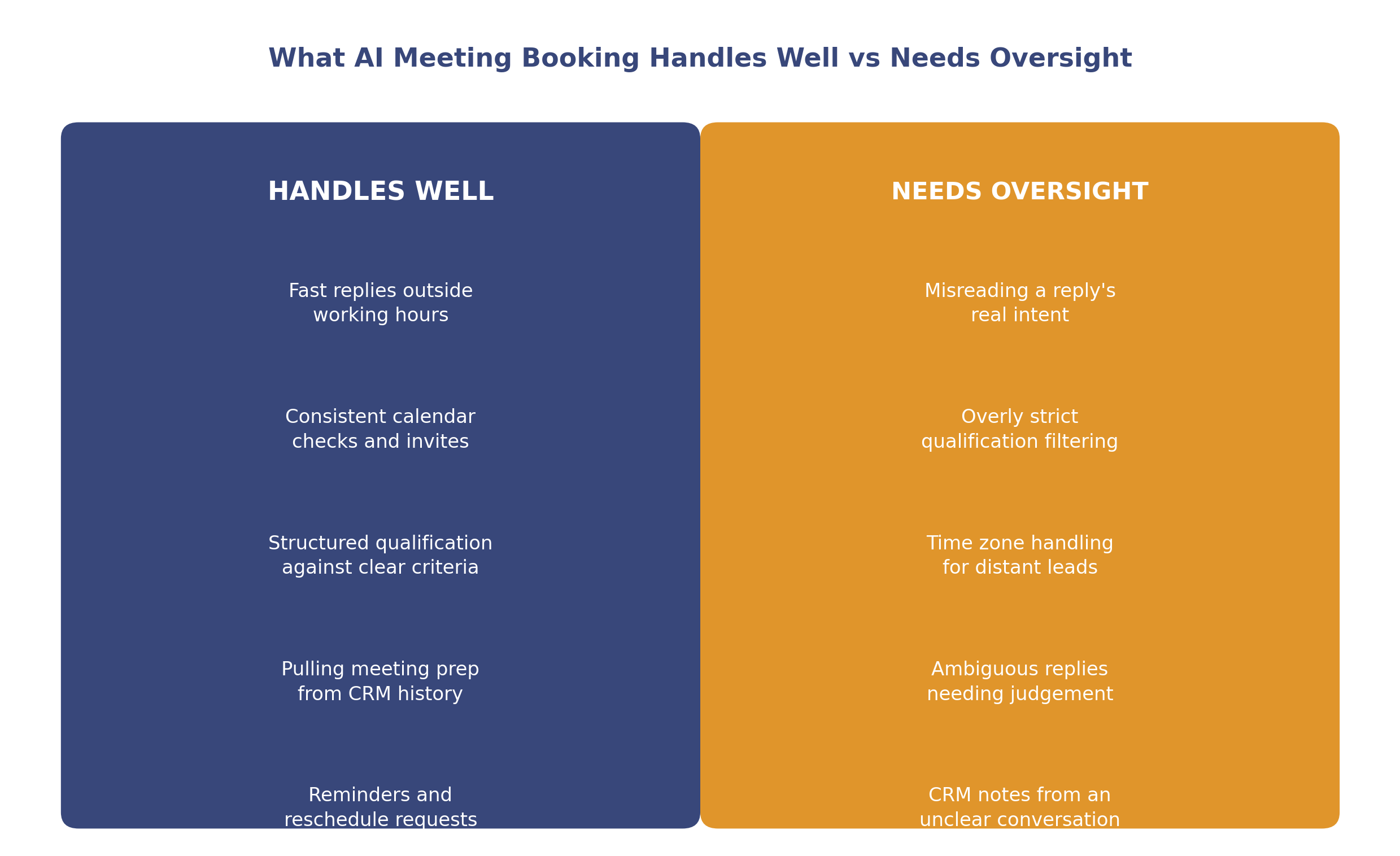
Illustrative summary. Your own data quality and review process still determine which side of this list you land on.
What Happens After the Meeting Is Booked?
Once a meeting is on the calendar, the work is not finished. An AI agent can continue to manage the details: sending reminders, handling last-minute reschedule requests, and keeping meeting details accurate across every invite, including time zones, which is a common source of small errors when a rep is juggling several conversations at once.
After the call, the same agent can log notes back into the CRM and trigger the next step in the workflow, whether that is a proposal, a follow-up call, or a nurture sequence for a meeting that did not progress. This keeps the pipeline updated without a rep needing to manually update every record by hand, provided the agent's CRM permissions are scoped correctly, and its updates are checked periodically.
What This Costs
Cost depends on the scope of the workflow rather than a fixed price for "AI scheduling" as a category. Based on typical UK small business projects:
A defined scheduling and qualification workflow: commonly £3,000 to £10,000 to build, covering calendar and CRM integration, qualification logic and escalation rules
A fuller build that adds meeting prep and post-call follow-up: tends to sit toward the higher end of that range, or into custom-build territory, depending on how many systems it touches
Ongoing monthly cost: typically £200 to £800 for monitoring, maintenance and usage, scaling with volume
These figures reflect general UK market ranges for a custom build rather than a fixed price for any specific project. Subscription-based scheduling and sales engagement tools are often priced differently, on a monthly or per-seat basis. A more detailed breakdown of what drives automation pricing is covered in our guide to AI automation pricing.
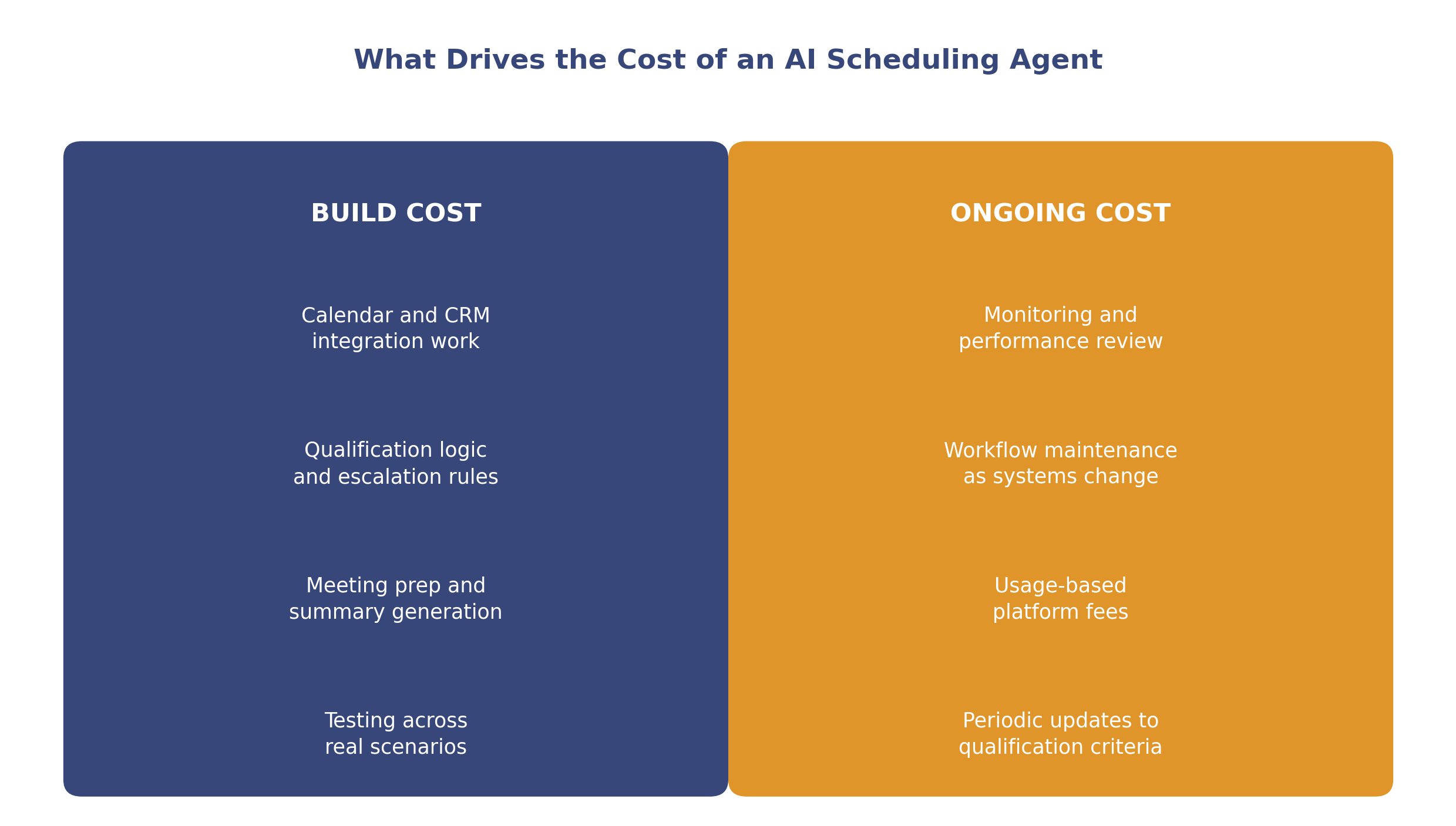
Illustrative cost drivers. Actual pricing depends on scope, integrations and how much of the workflow is automated end-to-end.
Where AI Scheduling Can Go Wrong
A fair account of this technology has to include where it fails, not just where it helps. Current AI scheduling and qualification agents can still:
Misread a reply's intent, treating a polite decline as interest or a request for more information as a booking request
Offer times that do not actually reflect a rep's real availability if calendar syncing is misconfigured
Apply qualification criteria too strictly, filtering out a lead that a person would have recognised as a good fit
Get time zones wrong, particularly for leads outside the business's home region
Continue a scripted booking flow in a situation that calls for stopping and handing over to a person
Log inaccurate or incomplete notes back into the CRM if the source conversation was ambiguous
None of this makes the technology unsuitable. It means a tested escalation path, a human review step during the early stages, and periodic checks on qualification accuracy matter more than how polished the booking experience looks in a demo.
Governance and Data Considerations
An agent with access to a calendar, a CRM and an email or chat channel is handling genuine business and personal data, and the same basic discipline that applies to a human employee doing the same task should apply here too.
Only connect the calendar, CRM and messaging permissions the workflow genuinely needs
Keep a record of what the agent can do without approval, such as booking directly versus proposing a time for confirmation
Log what the agent does, not just what it was told, so actions can be reviewed and errors traced back to a cause
Set a clear escalation path for replies the agent is not confident about, and monitor how often it is actually used
If the same system is also responsible for the initial outreach that generated the reply, the UK GDPR and PECR considerations covered in our AI sales outreach guide apply to that part of the workflow
AI does not remove your compliance responsibilities. Businesses still need to consider lawful basis, data retention, opt-outs and where enrichment data actually comes from, whether a person or an agent is the one acting on it.
For businesses scoping their first agent, our guide on writing an AI agent brief covers how to define permissions and escalation rules before development starts.
What to Look for in an AI Sales Platform
Not every platform marketed for this purpose covers the same ground. Before comparing vendors, it is worth checking whether a platform actually offers:
Native CRM integration, rather than a workaround built on exports and imports
Real calendar integration that reflects genuine rep availability, not a static link
Configurable qualification logic, rather than a fixed, one-size-fits-all script
A clear human handoff point for replies the system is not confident about
Visible conversation history, so a rep can see exactly what the agent said and why
Basic reporting on response time, booking rate and qualification accuracy
Clarity on where data is processed and stored, particularly for any enrichment features
Support for the specific channels your leads actually reply on, not just email
A platform that cannot show you what it is doing, and why, is harder to trust with real conversations, regardless of how capable the demo looks.
Choosing the Right Setup for Your Sales Team
The right starting point depends on where the actual bottleneck sits. If replies are being missed or answered slowly, start with the booking and confirmation layer. If reps are walking into calls under-prepared, meeting prep is likely the higher-value place to start. Trying to automate the entire process at once, from first reply through to post-call follow-up, is harder to test and harder to trust than building one piece at a time.
Teams with higher reply and meeting volume tend to see the time saved compound fastest, simply because there is more repetitive work to remove. That said, even a small sales team can free up a meaningful amount of time once scheduling and prep stop eating into the working day. Our guide to AI agent vs chatbot covers the broader distinction between a system that only answers questions and one that can actually complete a task like this end to end, which is useful context when evaluating vendors.
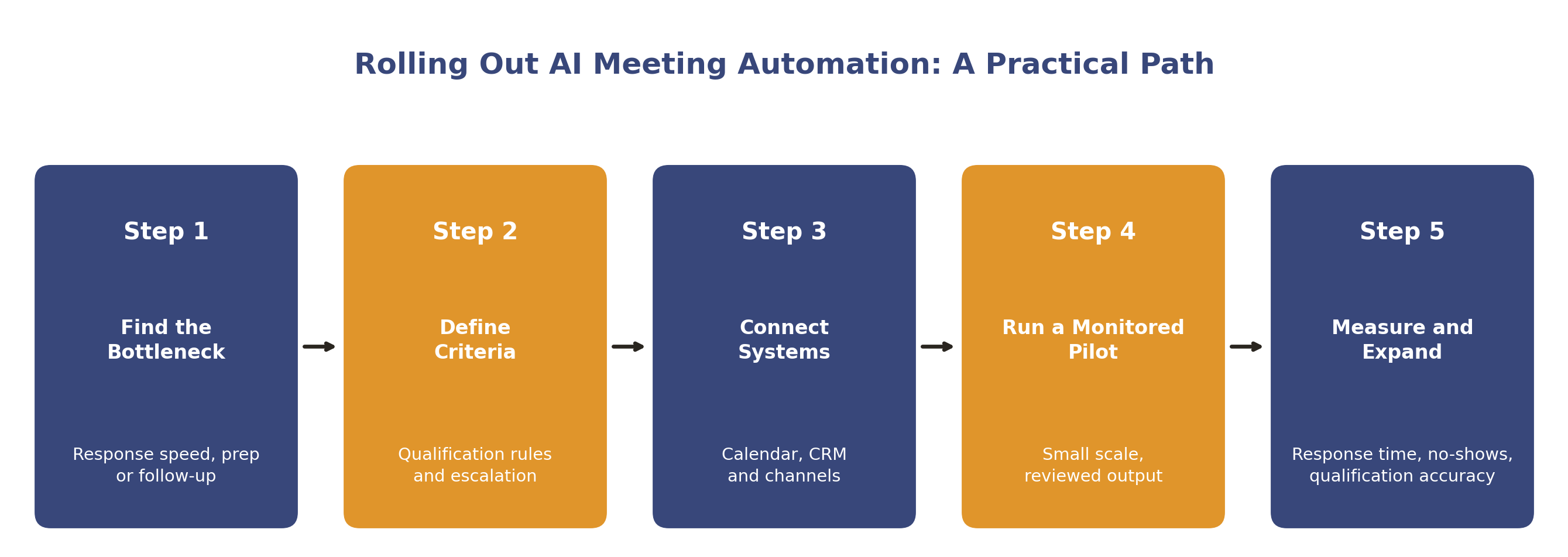
Illustrative roadmap. Pace depends on reply volume, data quality and how much oversight the use case warrants.
How to Measure Whether It's Working
Meetings booked alone is not a sufficient measure, since a system can produce more meetings while lowering their quality. A broader set of indicators gives a clearer picture:
Response time to a reply, and how consistently that response goes out
No-show rate, before and after introducing the workflow
Qualification accuracy, checked against which meetings actually progressed
Rep-reported usefulness of meeting prep summaries
CRM data accuracy and how often a human correction is needed
Time saved per rep, measured against a real baseline rather than assumed
Review these over several weeks of real activity before deciding whether to expand the workflow to a new team or channel.
Frequently Asked Questions
Is AI sales meeting automation the same as a scheduling link?
No. A scheduling link only shows open slots. An AI agent reads the actual reply, understands intent, qualifies the lead where relevant, and can prepare context for the rep before the call, not just find a time.
Will this replace the sales conversation itself?
No. It handles the admin around booking, qualifying and preparing for a meeting. The conversation, and the judgement that goes with it, still sits with the rep.
How much does an AI scheduling agent cost?
A defined workflow commonly costs £3,000 to £10,000 to build, with £200 to £800 a month in ongoing costs. Subscription-based tools are often priced differently, so it is worth checking which pricing model a quote is based on.
Can an AI agent qualify leads accurately?
It can, provided the qualification criteria are clearly defined and reviewed periodically. Criteria that are too broad or left to the model's own judgement tend to perform less reliably than a narrow, tested set of questions.
What is the biggest risk of automating meeting booking?
Misreading a reply's intent or applying qualification criteria too strictly, which can filter out a genuinely good-fit lead. A human review step during the early stages of a rollout reduces this risk.
Does this apply to UK GDPR and PECR?
The scheduling and prep layer itself is usually lower-risk, since it responds to a lead who has already engaged. If the same system also handles the initial outreach, the outreach-specific compliance considerations apply to that part of the workflow.
How do I know if my sales team is ready for this?
If replies are being missed, follow-ups are inconsistent, or reps are spending noticeable time on scheduling and prep instead of selling, that is usually a reasonable starting signal.
Can AI agents handle phone-based meeting booking?
Some AI sales agents extend into voice, calling a prospect, qualifying interest and scheduling a meeting directly over the phone rather than by message. Voice introduces additional considerations around disclosure, consent and call quality, so it is worth treating as its own deployment rather than assuming the same rules as written scheduling apply. Our AI voice agents guide covers this in more detail.
Key Takeaways
AI sales meeting automation handles the admin around booking, qualifying and preparing for a call, not the sales conversation itself
AI agents can read a reply, offer suitable times and confirm a booking without a person carrying out each step
Qualification before a meeting reduces time spent on leads that were never a realistic fit, provided the criteria are clearly defined
Better meeting prep tends to make the call itself more productive, though the effect varies by deal type
A defined scheduling and qualification workflow commonly costs £3,000 to £10,000 to build, with £200 to £800 a month ongoing
Misread intent and overly strict qualification are the most common failure points, and both benefit from a human review step early on
Start with the specific bottleneck in your process, response speed, prep, or follow-up, rather than automating everything at once
Track response time, no-show rate and qualification accuracy, not meetings booked alone
Find Out Where AI Can Remove Your Sales Admin Bottlenecks
Not sure where the biggest bottleneck sits in your current booking and follow-up process? We'll help you identify where an AI agent can genuinely save time without adding risk.
About the Author
Seth Ayush is Co-Founder of AI Workforce, a British AI company building AI agents for UK businesses. He works on how AI Workforce's outreach and workflow agents are designed, tested and deployed, with a focus on getting reply handling and escalation logic right before a system is trusted with real prospects.
Reviewed: August 2026