AI Lead Generation Tools: A Practical B2B Guide
Posted On: July 9, 2026
Last updated: August 2026 · Written by Luca Controlo, Content Marketing Specialist · Reviewed by Rodi Taze, Co-Founder of AI Workforce
Building a prospect list manually can take hours of research for every campaign. AI lead generation tools reduce that work considerably by discovering accounts, enriching contacts and prioritising prospects automatically. The challenge is knowing which results you can trust, and which still need human validation. This guide explains what these systems actually do, where they commonly go wrong, and how to evaluate, govern and measure one without damaging your data, your sender reputation or your compliance position.
Quick Answer: AI lead generation tools use AI to find accounts, research and enrich contact details, flag possible buying signals, score records against your ideal customer profile, and often move straight into outreach. These platforms can produce a prioritised prospect list quickly, but the underlying data and scoring still need validation before the list is used for outreach. Treating a raw export as a sales-ready lead, rather than a starting point, is the most common way these tools underperform.
At a Glance
What it is: software that automates account discovery, contact enrichment, intent monitoring, scoring, qualification and often outreach, usually plugged into a CRM
What it does well: high-volume research and structured data collection far faster than most teams could manage manually
Where it commonly fails: stale or inferred contact data, misread intent signals, and scoring that reflects historic bias rather than current fit
Key legal considerations: UK GDPR for any identifiable business contact, and PECR separately for marketing emails, texts or calls
Safest way to evaluate a tool: test it against your own list, including known good-fit, poor-fit and outdated records, before trusting it with a live campaign
What's Covered
What Are AI Lead Generation Tools?
The Seven Functions Often Grouped Under "AI Lead Generation"
How AI Lead Generation Actually Works
What These Tools Do Well
What AI Still Can't Do Reliably
Where They Commonly Go Wrong
Data Sources, Enrichment and Intent Signals
UK GDPR and PECR for AI Lead Generation
Deliverability and Platform-Term Risks
What AI Lead Generation Tools Cost
How to Evaluate a Vendor
A Controlled Pilot Plan
Metrics That Matter
Are AI Lead Generation Tools Worth It?
Frequently Asked Questions
Key Takeaways
What Are AI Lead Generation Tools?
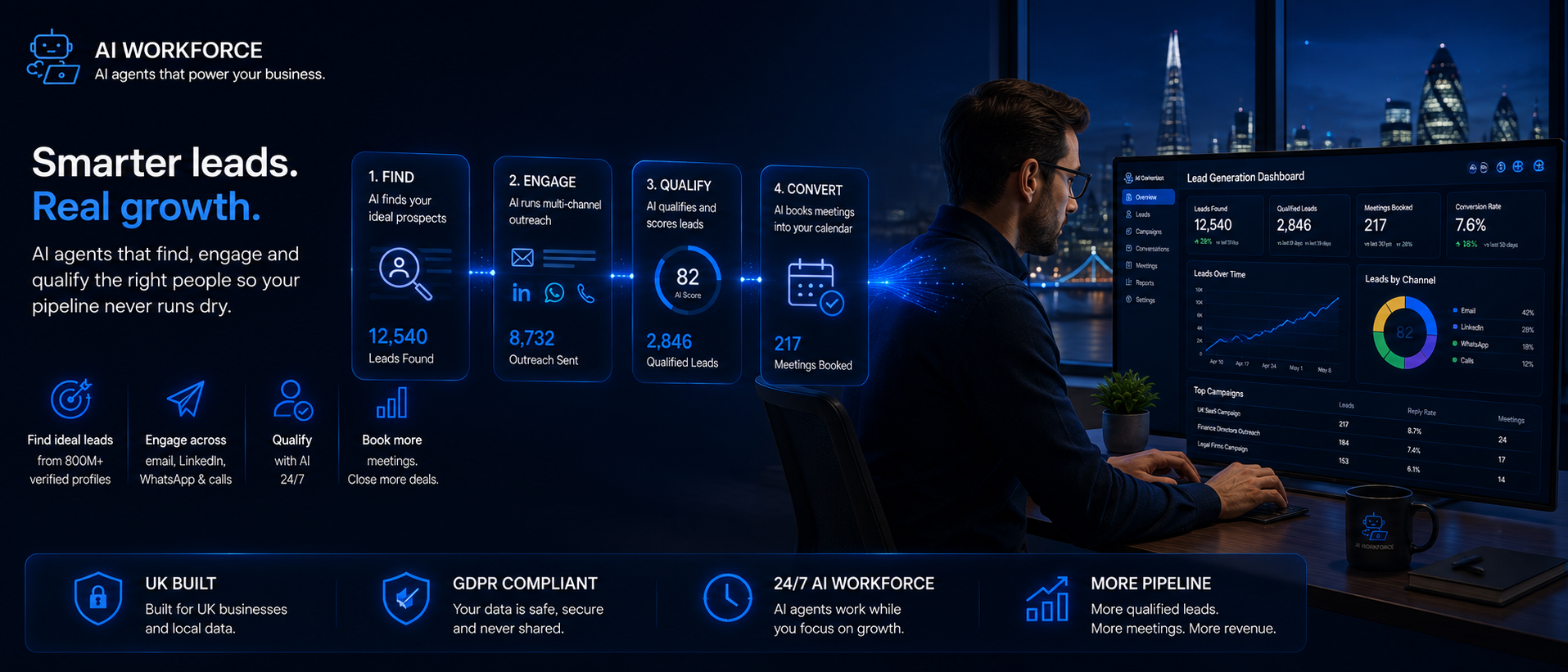
At the simplest level, these are systems built to find, research and rank potential buyers with less manual work from a rep. A basic version might pull contact details from a licensed database. A more advanced tool can also monitor company news for possible signals of relevance, apply a predictive score and suggest who to contact first.
Most plug into a CRM, so records do not need to be copied by hand. The line between a narrow prospecting tool and a full sales platform has blurred, since many products now bundle discovery, enrichment, scoring and outreach into one system rather than selling them separately, an overlap covered in our wider roundup of AI sales assistant software. That bundling is convenient, but it is also why "AI lead generation" gets used as a catch-all term for several genuinely different functions, each with its own risk profile.
The Seven Functions Often Grouped Under "AI Lead Generation"
Treating every AI lead generation feature as equivalent is one of the more common mistakes buyers make. It is worth separating what is actually happening at each stage:
Lead discovery: finding accounts and contacts that match defined criteria
Data enrichment: adding firmographic details, contact information and technology stack to a thin record
Intent and signal monitoring: flagging activity that may suggest relevance or possible buying interest
Lead scoring: prioritising records, often by comparing them against patterns in historical customers
Lead qualification: testing a record against agreed fit criteria before a rep spends time on it
Outreach automation: sending messages and follow-up sequences, covered in more depth in our guide to automating sales outreach with an AI agent
Pipeline management: routing records, updating the CRM and reporting on outcomes
Each of these carries a different level of risk and needs a different level of human review. Discovery and enrichment are largely about data accuracy. Scoring and qualification are about whether the criteria are still valid. Outreach automation is where UK marketing law and deliverability risk enter the picture directly. Keeping these functions distinct, rather than treating "AI lead generation" as one product, makes it much easier to evaluate a vendor and decide where automation is actually safe to trust.
Set side by side, the main benefit and the biggest risk of each function looks like this:
Discovery: finds matching companies, but can miss genuinely relevant targets outside its defined criteria
Enrichment: produces more complete records, but can introduce stale, mismatched, inferred or model-generated information
Intent monitoring: helps prioritise attention, but is prone to false positives from ambiguous signals
Scoring: sharpens focus onto better-fit accounts, but can encode historic bias from past pipeline data
Qualification: saves a rep's time, but can wrongly exclude a genuinely good-fit account
Outreach: adds genuine scale, but raises deliverability and compliance risk if list quality is poor
Pipeline management: improves reporting and visibility, but bad automation here can write incorrect data back into the CRM at scale
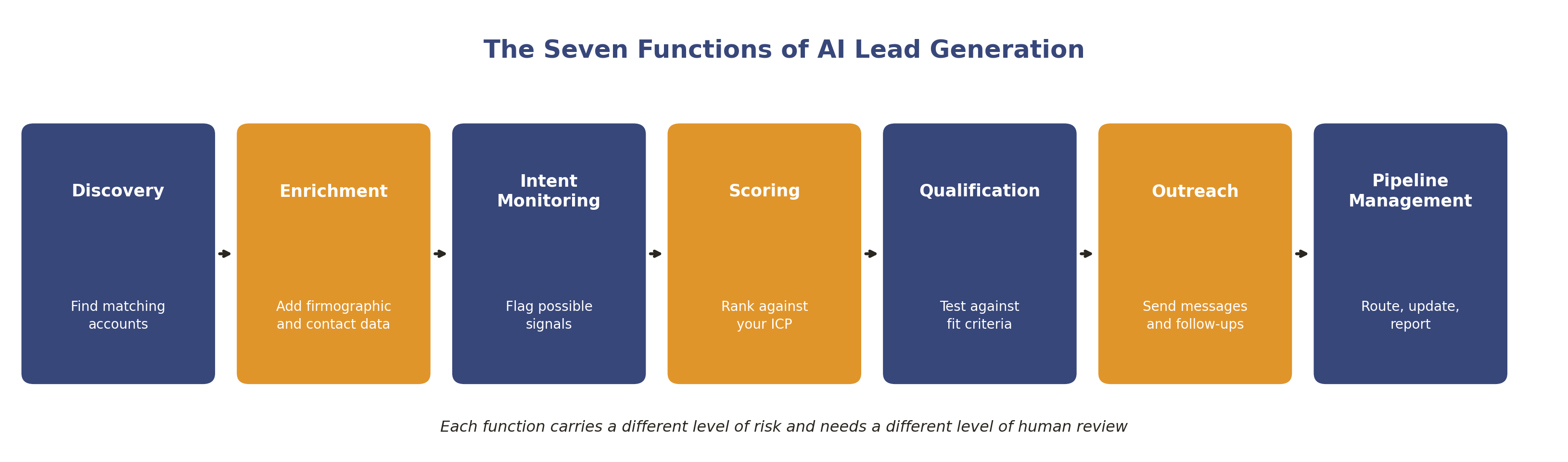
Illustrative flow. Each function carries a different level of risk and needs a different level of human review.
How AI Lead Generation Actually Works
Behind the interface, a system typically pulls data from public sources, licensed data partners, your CRM and past deal history, then applies a model trained to spot patterns across that data. Straightforward automation handles the repetitive parts, such as checking a company's size or sector, so a person does not have to do it manually for every record.
Scoring engines often compare a new contact with patterns found in historical customers and closed opportunities. That can genuinely improve prioritisation, but only where the underlying CRM data is representative, accurate and still relevant to the current go-to-market strategy. Historical pipeline data can just as easily reflect previous targeting bias, missing or inconsistent records, one unusually successful segment, territories a team happened to cover, or legacy pricing and positioning that no longer applies. A score built on that foundation tells you what looked good in the past, not necessarily what is a strong fit today.
Clean lead data matters more than a clever model at this stage. Even a well-built scoring algorithm produces weak results if the underlying records are outdated, duplicated or incomplete, and that dependency on data quality is one of the main reasons these tools disappoint teams that adopt them without checking their own CRM first.
What These Tools Do Well
Used deliberately, AI lead generation genuinely removes hours of repetitive work:
Researching a large number of accounts in parallel, rather than one at a time
Pulling firmographic details, recent news and technology stack into a single record automatically
Applying consistent scoring criteria, so sales and marketing stop arguing over which leads are worth chasing
Surfacing lookalike accounts that resemble existing best-fit customers, as a starting point for further research
Keeping inbound and outbound activity in the same connected system, rather than scattered spreadsheets
Sales teams are adopting this kind of tooling quickly. Salesforce's State of Sales 2026 report found that 34% of sales teams already using AI agents use them specifically for prospecting, and 92% of sales professionals with access to agents say AI benefits the prospecting stage of their work. That is a genuine signal of perceived value, though it is vendor-reported survey evidence about sentiment and adoption, not proof that any specific platform improves conversion or revenue for your business. Treat it as a reason to evaluate the category seriously, not as a guarantee of results. For a broader look at how these agents fit alongside human reps, see our comparison of AI SDRs and human SDRs.
What AI Still Can't Do Reliably
Set against that genuine value, it is worth being equally clear about what these tools are not good at, since most of the disappointment around AI lead generation comes from expecting it to do things it was never actually equipped to do:
Read office politics or figure out who genuinely holds the budget within a buying committee, as opposed to who holds the most senior title
Detect a change in budget or priority that has not yet shown up anywhere in public or licensed data
Build the kind of trust and relationship history that shortens a sales cycle, particularly for higher-value or longer-consideration purchases
Explain, with any real confidence, why a specific deal went cold or a specific prospect went quiet
Judge internal politics, competing priorities, or timing issues that a rep would normally pick up from a real conversation
None of this makes the category less useful. It means AI lead generation is best treated as a research and prioritisation layer that feeds a rep's judgement, not a replacement for it.
Where They Commonly Go Wrong
A "ready" list from an AI lead generation tool is rarely as ready as the label implies. In practice, exported records can include outdated job titles, incorrect contact details, duplicated people, the wrong person at a similarly named company, inferred email addresses that have never been validated, and companies that fall outside the intended criteria despite scoring well.
A newer risk worth watching for specifically is hallucinated enrichment. Where a tool uses a language model to fill gaps in a thin record rather than retrieving verified data, it can generate a plausible-sounding but incorrect job title, company description or summary. A confident, well-written record is not the same as an accurate one, and this is a growing risk as more enrichment tools lean on generative AI rather than licensed data lookups.
A lead score can be wrong for several distinct reasons, and it is worth understanding which one applies before trusting it:
The source data was already stale by the time it reached the model
The account resembles past customers only on the surface, not on the factors that actually drove those deals
Activity reflects research or curiosity rather than genuine purchase intent
Multiple people share similar names or job titles, and the wrong one was matched
The company has changed strategy or buying priorities since the historical data was collected
The model is optimising for a proxy, such as reply rate, rather than for revenue or fit
The scoring criteria were set for an earlier stage of the business and exclude a genuinely relevant emerging segment
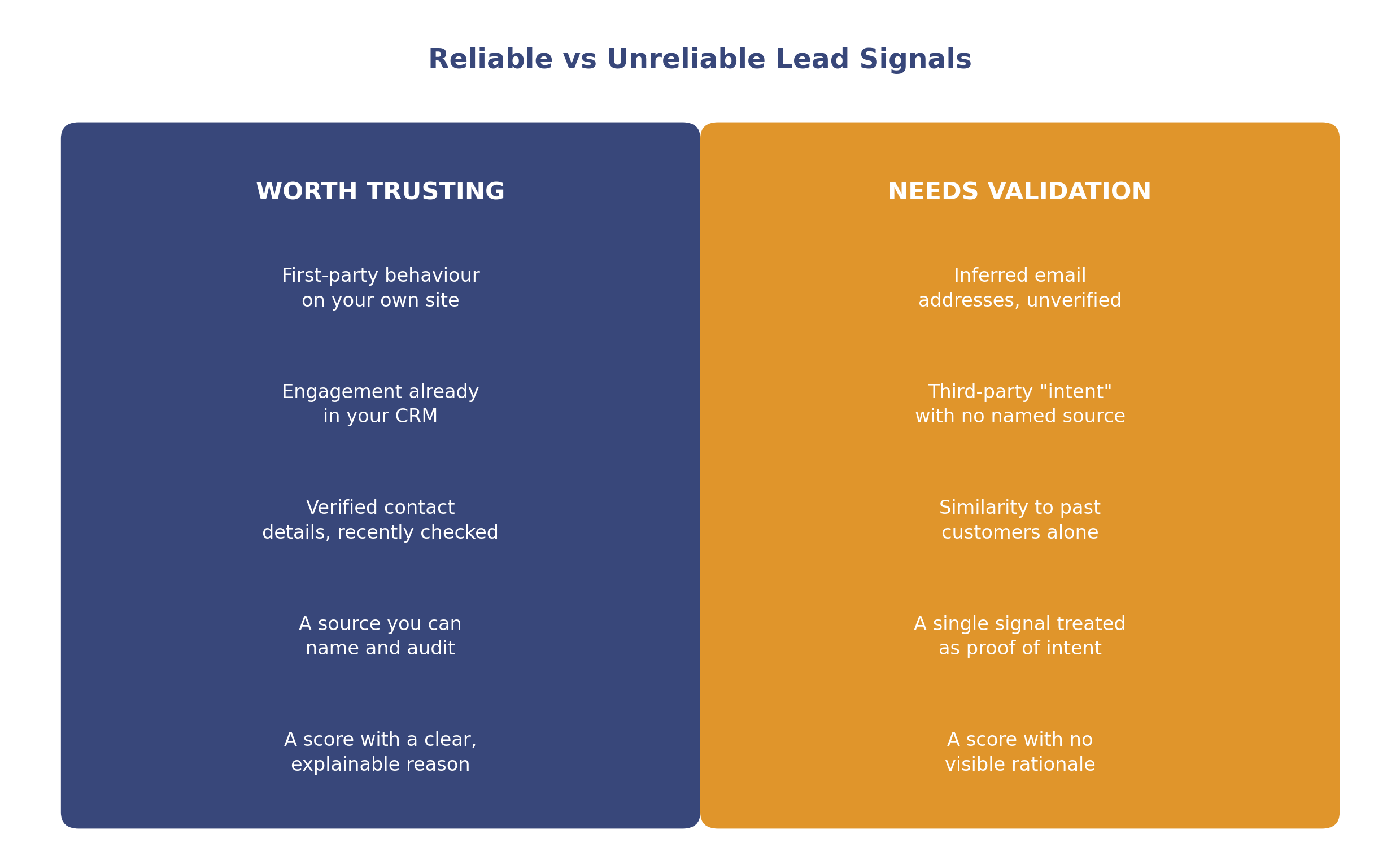
Illustrative comparison. Treat every signal as a clue that narrows where to look next, not proof of intent.
A high score is a prioritisation signal, not a statement of fact. Salesforce's own data-quality research points in the same direction: 74% of sales professionals report they are actively working on data cleansing to get more value from AI, and 51% of sales leaders using AI say disconnected systems are slowing their AI initiatives down. Those figures describe a live, unresolved problem across the industry, not a solved one, which is exactly why validation matters more than the marketing around any single platform suggests.
Data Sources, Enrichment and Intent Signals
Not all lead data is collected the same way, and buyers should ask directly where a given field came from before relying on it. Common sources include public company websites, official company registries, licensed data partners, user-contributed databases, inferred address or email patterns, professional networks, and scraped public pages. These sources are not equivalent in reliability, freshness or legal standing, and a vendor should be able to explain which applies to which field, not describe the whole dataset as one undifferentiated pool.
Intent data deserves particular care. A tool that claims to "identify intent" is really identifying signals that may suggest relevance or possible buying activity, not demonstrated buying intent. Worth distinguishing between the main categories:
First-party behavioural signals, such as a visit to your own pricing page
Third-party topic or research signals, such as engagement with related content elsewhere
Company-change signals, such as a funding round, a relevant job advert or a senior hire
Engagement history already recorded in your own CRM
Inferred fit based on similarity to existing customers, rather than any observed activity at all
A website visit, a job advert or a funding announcement may indicate relevance. None of them proves that a company is actively looking to buy right now. Treat every signal as a clue that narrows where to look next, not as proof that justifies skipping validation.
UK GDPR and PECR for AI Lead Generation
AI lead generation does not sit outside UK data protection and marketing rules simply because the contacts are business prospects rather than consumers. This section is general information rather than legal advice, but it sets out the main obligations that apply once a tool is processing named business contacts.
UK GDPR applies wherever a platform processes information relating to an identifiable person, and that includes named employees, directors and sole traders held in a lead generation or enrichment database. If a record identifies no individual, for example a generic address such as info@company.co.uk, it generally involves less personal data processing than a record naming a specific person, though the content and surrounding data still matter. Our guide to AI and GDPR compliance for UK businesses covers the underlying framework, including lawful basis, data minimisation and vendor due diligence, in more depth.
Corporate versus individual subscribers matters directly once a tool is used to send messages, because PECR governs marketing emails, texts and calls separately from UK GDPR. Under current ICO guidance, you must not send marketing emails or texts to individuals without specific consent, subject to a limited exception, often called the soft opt-in, for your own previous customers who bought or discussed buying a similar product from you and were given a clear opt-out. You can email or text corporate bodies, such as companies, Scottish partnerships, LLPs and government bodies, without that same consent requirement. That does not remove the requirement to identify your organisation clearly and give a valid address for the business to opt out or unsubscribe, and it remains good practice to maintain a do-not-contact list for anyone who objects. Sole traders and some partnerships are treated as individuals rather than corporate bodies for this purpose, which is easy to miss when a lead list mixes company types.
Legitimate interests is not an automatic fallback. The ICO is explicit that this lawful basis cannot simply be assumed as the default option for prospecting activity. Using it properly requires a documented assessment covering purpose, necessity and a balancing test, and it depends on the processing being proportionate, having a limited privacy impact, and aligning with what the individual would reasonably expect.
A compliance checklist worth working through before scaling any AI lead generation activity:
A documented lawful basis for the personal data each tool processes, including a legitimate interests assessment where that basis is used
Clear identification of whether a contact is an individual, a sole trader or a corporate body, since the rules differ
A working suppression or do-not-contact list, screened before every send
Transparency about where personal data came from, particularly where it has been enriched or inferred rather than directly collected
A clear, working route for a contact to object to direct marketing, and a process to act on that objection promptly
Defined data retention periods for enrichment and scoring data, not an indefinite default
An assessment of whether each vendor is acting as your processor, an independent controller, or a joint controller for the data it holds. Do not assume the contract's label settles this; the role depends on who actually decides the purposes and means of the processing
Awareness of where a vendor stores and processes data, including any international transfer
Channel-specific rules for outbound email, text and calling, since PECR treats live calls, automated calls and electronic mail differently
Deliverability and Platform-Term Risks
Beyond data protection law, AI lead generation and outreach tools carry a second category of risk: breaching the terms of the platforms the data or activity actually touches. Several major professional networks restrict automated access, scraping and third-party automation of member data. LinkedIn's user terms, for example, prohibit scraping and unapproved automated access to the platform, and treat this as a contractual matter enforceable against the account holder, not just the tool provider. A vendor offering LinkedIn-based enrichment or automation should be assessed against the platform's current terms, not simply on whether the workflow technically works today.
Before adopting a tool that touches a third-party platform, it is worth asking directly:
Is the data collected through an approved API or partner programme, or through scraping?
Does the workflow require sharing your account credentials with the vendor?
Could the activity breach the source platform's terms of service?
What happens if the source platform restricts or blocks the account's access?
Is your business responsible for account suspension risk, or does the vendor carry that risk?
Deliverability is a related, practical concern once outreach is switched on. Sending volume and list quality affect inbox placement regardless of how the list was built, and a technically compliant campaign can still fail commercially if domain reputation is damaged by poor list hygiene or a sudden jump in volume.
What AI Lead Generation Tools Cost
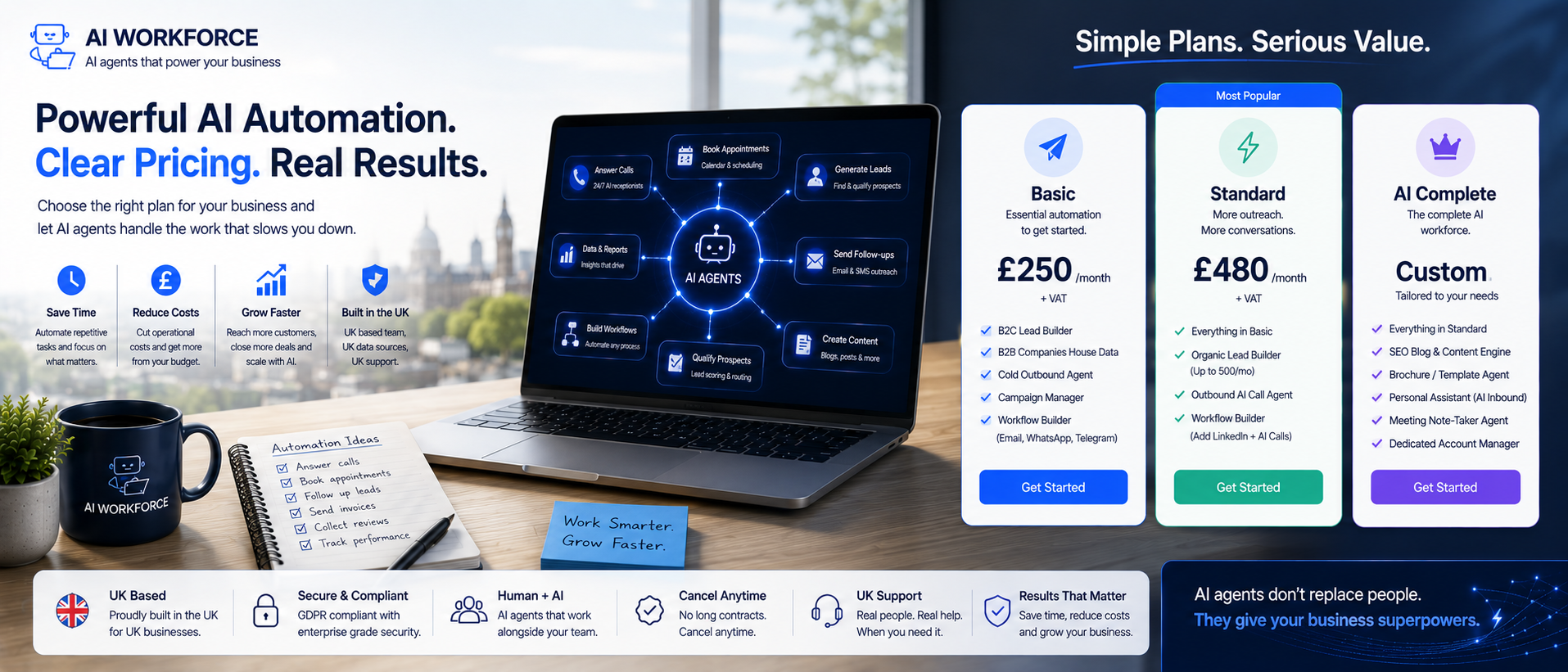
AI lead generation pricing tends to follow the same general pattern as AI automation projects across other business functions. Based on the types of UK small business automation projects AI Workforce encounters, as covered in our AI automation pricing guide, indicative ranges as of August 2026 are:
Simple automation (roughly £500 to £2,000): for example, routing enriched leads from a single source into a CRM with basic scoring rules
Mid-range build (roughly £3,000 to £10,000): for example, a multi-source enrichment and scoring workflow with defined qualification criteria and CRM write-back
Custom AI (£10,000 and up): for example, a bespoke scoring model trained on your own pipeline data, combined with outreach automation across multiple channels
Ongoing monthly cost (roughly £200 to £800): monitoring, maintenance and support, scaling with usage and complexity
DIY option: platforms such as Zapier, Make or n8n can bring a simple discovery-to-CRM workflow down to a monthly subscription of roughly £20 to £50, if someone in-house is comfortable configuring it, and our guide to building AI agents without code walks through that route in more detail
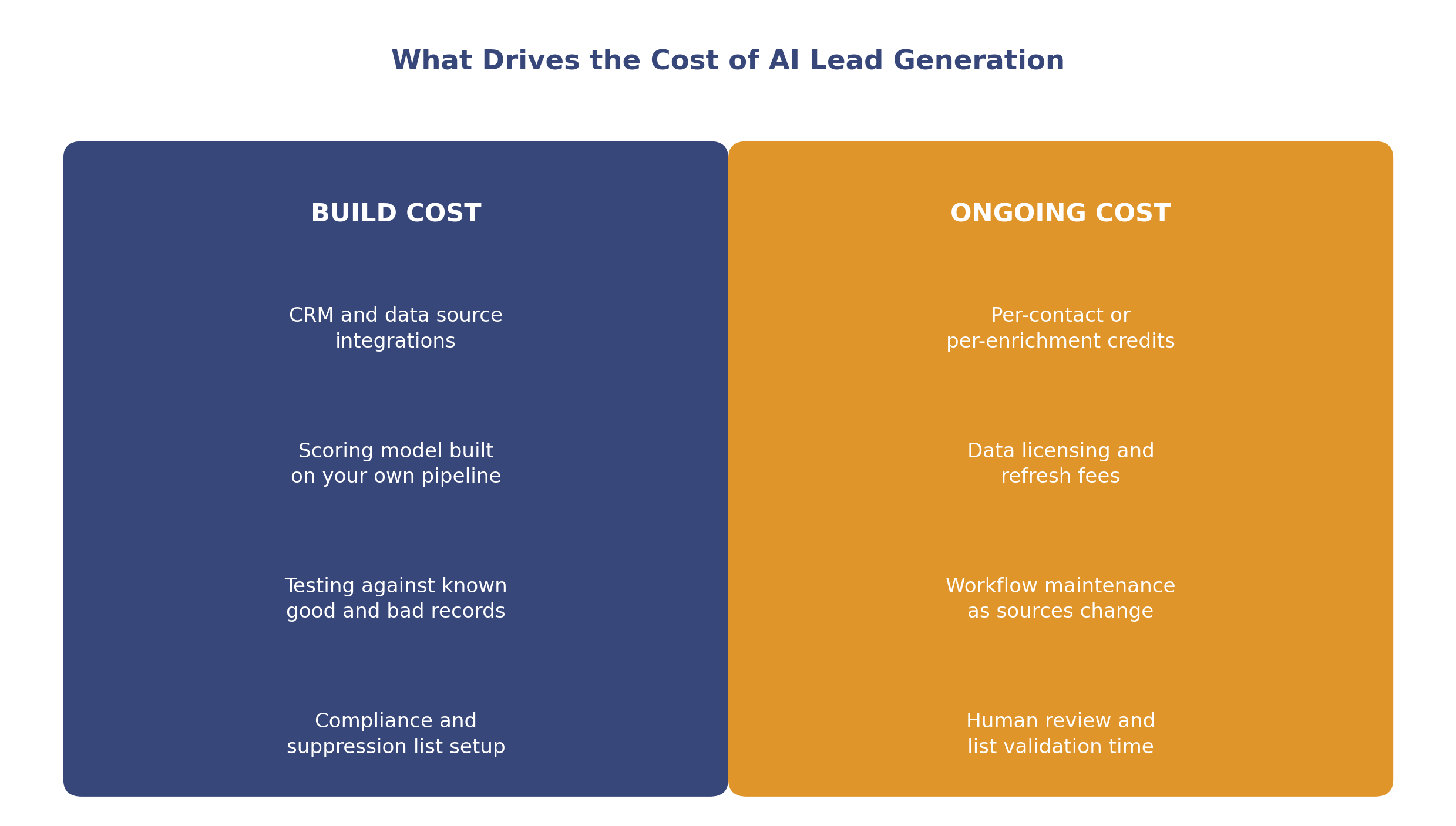
Illustrative cost drivers. Actual pricing depends on scope, data quality and how many systems are involved.
Beyond the build cost, most commercial lead generation platforms price the ongoing service separately, commonly through some combination of per-seat subscriptions, per-contact or per-enrichment credits, per-exported-record charges, or usage-based API costs. These vary considerably by vendor and are worth requesting as a clear, itemised breakdown rather than a single headline price, since the credit or per-record cost often ends up being the larger part of the total spend once a tool is used at real volume.
The most useful way to judge value is cost per usable lead: total platform, data and implementation cost, divided by the number of records that actually pass validation and match your criteria. For a genuinely commercial view, cost per accepted opportunity is a stronger measure still, since it accounts for how many of those usable leads actually progress.
AI Workforce Insight: the most difficult part of lead generation is rarely producing a large list. It is deciding which records are genuinely usable. We would rather see a smaller set with clear source evidence, valid contact details and a defined reason for the score than a large export a sales team has to clean manually before it is any use.
How to Evaluate a Vendor
Before committing to a platform, put these questions to the vendor directly and expect clear answers, not marketing language:
Where does each data field come from, and is it observed, licensed or inferred?
When was a given record last verified, and how is conflicting information resolved? When two sources disagree, does the system preserve both values and flag the conflict, or silently overwrite one, since that is a strong indicator of data governance quality
How often is each field actually refreshed, daily, weekly, monthly or quarterly, since refresh frequency is one of the biggest quality differences between providers
Can a contact request correction or removal, and does the provider retain the original source for that purpose?
Are customers told explicitly when an email address is only inferred rather than verified?
Does the provider use your CRM data to improve its own wider model, and can that be turned off?
Where is the data stored and processed, and does that involve a transfer outside the UK?
Is the underlying data collected through an approved API or partner programme?
Can you export a full audit log of what the tool did, including scoring rationale?
What does the tool do when it is genuinely uncertain, rather than returning a confident-looking score regardless?
A vendor that cannot answer most of these clearly, or that treats the question as unusual, is a signal to slow down. Writing these questions into a short brief before you contact vendors also makes it far easier to compare answers fairly. Our guide on how to write an AI agent brief covers the general format, and it applies just as well to a lead generation vendor as any other AI tool.
A Controlled Pilot Plan
Testing a tool against your own list, rather than a vendor's polished demo account, is good practice, but it needs a defined process to be useful. A practical four-week pilot:
Week one: define your ideal customer profile, exclusions and the fields you actually need, then agree what a usable record looks like before you see a single result
Week two: run the tool against a known sample containing good-fit, poor-fit and deliberately outdated records, so you can see how it handles cases where you already know the right answer
Week three: compare its accuracy against your current manual process, and inspect false positives individually rather than accepting an aggregate accuracy figure
Week four: use a limited live segment with human approval before anything is sent, and track outcomes through to accepted opportunity, not just export volume
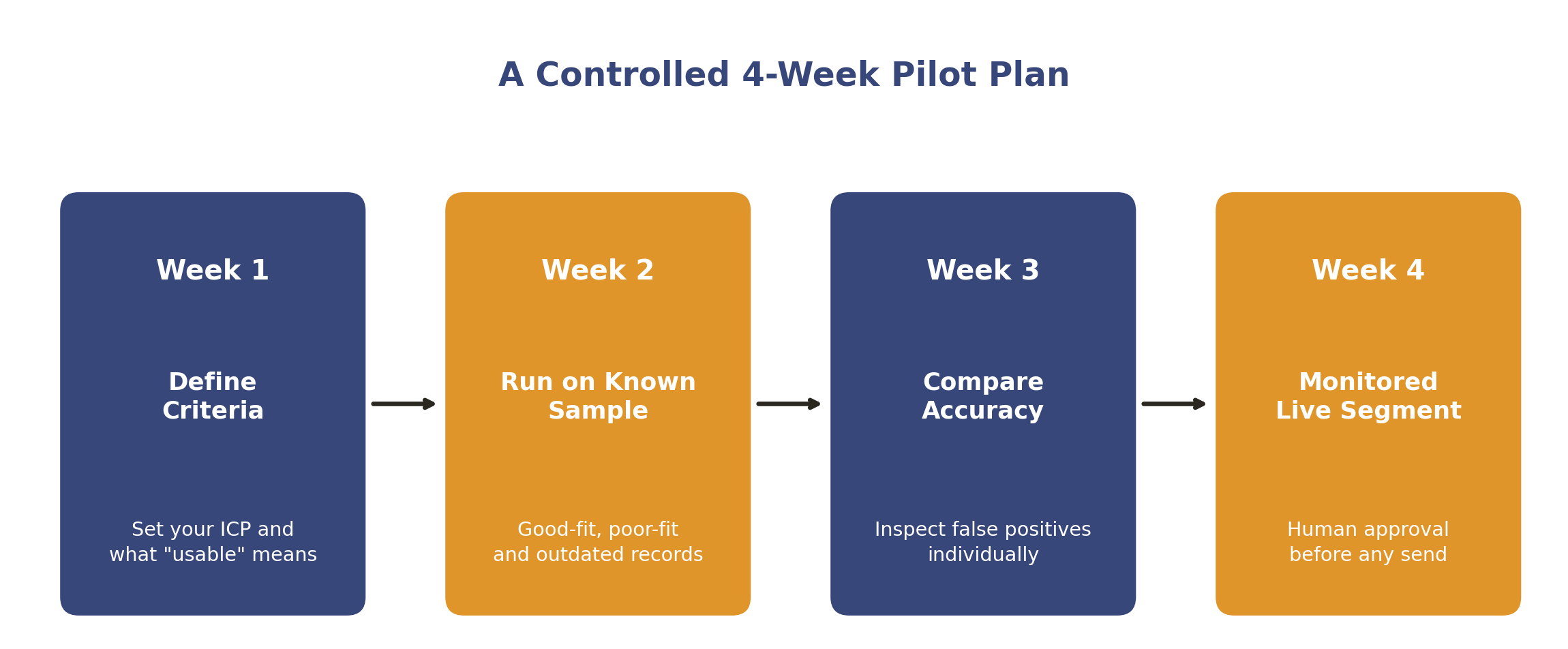
Illustrative roadmap. A smaller, more accurate list a rep can trust beats a large one that needs manual cleaning.
Do not judge success by how many records the tool returns. A smaller, more accurate list that a rep can trust is worth more than a large one that needs manual cleaning before use.
Metrics That Matter
A proper evaluation goes well beyond a single accuracy percentage. Track:
Valid-company rate and correct-person rate
Verified-email rate and phone-number accuracy
Duplicate rate and stale-record rate
Source transparency, whether each field's origin is disclosed
Geographic coverage relative to your actual target markets
Qualification accuracy, checked against what actually became a real opportunity
CRM-write accuracy, since incorrect automated updates can be worse than no update at all
False-positive rate on scoring
Opt-out and suppression matching accuracy
Cost per usable lead, and cost per accepted opportunity
Once outreach is switched on, it is worth tracking a second set of metrics that connect list quality to real campaign performance: hard-bounce rate, spam-complaint rate, unsubscribe rate, mailbox-provider deferral or block rate, positive-reply rate by data source, and any change in domain reputation after launch.
Reviewing these after a genuine pilot period gives a far more honest picture than judging a new tool on export volume in its first week. If leads pass validation, the next stage is usually booking a conversation, and our guides to AI SDR tools for outbound and AI sales meeting scheduling cover that handoff in more detail.
Are AI Lead Generation Tools Worth It?
AI lead generation tools are worth evaluating where manual research, enrichment and qualification consume significant sales time. Their value depends on how many records pass validation, progress into accepted opportunities and do so without creating compliance, CRM or deliverability problems. Measure cost per usable lead and cost per accepted opportunity rather than list size alone before judging whether a tool has paid for itself.
Frequently Asked Questions
What do AI lead generation tools actually do?
They automate parts of finding and qualifying B2B buyers: discovering accounts, enriching contact and firmographic data, monitoring possible intent signals, scoring records against your ideal customer profile, and often extending into outreach. Each of these carries a different level of risk.
Are AI lead generation tools accurate?
Accuracy varies significantly by source, geography and data type. These tools can speed up research and enrichment considerably, but company identity, contact role, email validity and the reasoning behind a lead score should all be checked before a record is used for outreach.
How much do AI lead generation tools cost?
Simple automation typically starts from around £500. Mid-range workflows commonly run £3,000 to £10,000 to build, with £200 to £800 a month in ongoing costs. Many commercial platforms also charge per contact, per enrichment or per exported record on top of any subscription, so ask for an itemised cost breakdown.
Is AI lead generation legal in the UK?
It can be lawful, but UK GDPR applies to any identifiable business contact, and PECR applies separately to marketing emails, texts and calls. Businesses need a lawful basis, transparency about data sources, a working suppression list, and channel-specific compliance for outbound messaging.
What is the difference between lead scoring and intent data?
Lead scoring ranks a contact against defined or historical criteria, such as similarity to past customers. Intent data flags signals, such as a website visit or a relevant job advert, that may suggest relevance or possible buying activity. Neither is proof that a company is currently ready to buy, and both work best as inputs to human judgement rather than automated decisions on their own.
Does using AI for prospecting remove the need for a human review step?
No. A high lead score or a strong intent signal is a prioritisation aid, not a verified fact. Validating company identity, contact accuracy and scoring rationale before outreach is what turns a raw export into a usable lead. For strategic or high-value accounts specifically, it is worth requiring manual verification of the company, decision-maker, contact details and personalisation source before the first message is sent, rather than applying the same light-touch validation used for scaled outreach.
Are inferred business email addresses reliable?
An inferred email is generated from a likely company naming pattern rather than confirmed from a direct source. It may well be correct, but it should not be treated as verified until it has passed an appropriate validation check. Inferred addresses generally carry a higher bounce and data-quality risk than observed or recently verified addresses.
Can a business contact ask to be removed from an AI lead database?
Individuals can object to their personal data being used for direct marketing, and businesses should maintain a suppression record so the contact is not added back into future campaigns. Whether the underlying vendor must delete or correct the record depends on its own role and the circumstances, so it is worth checking a provider's correction and removal process before relying on its data.
Can a lead generation tool get us in trouble with LinkedIn or similar platforms?
Potentially, yes. Several major platforms restrict scraping and unapproved automated access in their terms of service, and this is enforceable against the account holder, not only the tool provider. Ask any vendor whether their data collection uses an approved API or partner programme before connecting a business account.
Should AI-generated lead lists replace manual prospecting?
No. AI should reduce the amount of manual research required, not eliminate human judgement. Most businesses achieve the best results by using AI to prioritise accounts while allowing sales teams to verify important prospects before outreach.
Key Takeaways
"AI lead generation" covers seven distinct functions, discovery, enrichment, intent monitoring, scoring, qualification, outreach and pipeline management, each with a different risk profile
A fast, well-scored export is not automatically a validated, sales-ready lead; treat it as a prioritised starting point
Lead scores can be wrong for specific, identifiable reasons, including stale data, superficial similarity to past customers, and criteria that no longer match the current go-to-market strategy
UK GDPR applies to any identifiable business contact, and PECR applies separately to marketing emails, texts and calls, with different rules for individuals, sole traders and corporate bodies
Platform terms matter as much as data protection law; scraping or unapproved automated access can put an account at risk regardless of workflow effectiveness
Realistic costs range from roughly £500 for simple automation to £3,000 to £10,000 for a mid-range build, plus £200 to £800 a month in ongoing costs, before any per-contact or per-enrichment fees
Evaluate a vendor on data provenance, source transparency and a genuine four-week pilot against your own list, not a polished demo
Measure cost per usable lead and cost per accepted opportunity, not export volume alone
This article is general information rather than legal advice. The core UK GDPR and PECR rules are established, but regulatory guidance, enforcement priorities and the way they apply to newer AI enrichment and outreach systems continue to develop. Take independent legal advice before relying on AI-sourced or AI-enriched data for a live marketing campaign.
Ready to Introduce AI Lead Generation Safely?
We'll help you assess which parts of your prospecting process are genuinely ready for automation, check the data and compliance risks in the parts that are not, and build a properly governed pilot before you rely on AI-sourced leads for a live campaign.
About the Author
Luca Controlo is a Content Marketing Specialist at AI Workforce, a British AI company building AI agents for UK businesses. He writes blogs, whitepapers and guides that explain technical AI concepts and compliance considerations to everyday business buyers, working closely with AI Workforce's product and operations teams to keep the explanations accurate.
This article was reviewed by Rodi Taze, Co-Founder of AI Workforce, who works on how AI Workforce's outreach and workflow agents are designed, tested and deployed, with a focus on data quality, escalation logic and compliance before a system is trusted with real prospects.
Reviewed: August 2026