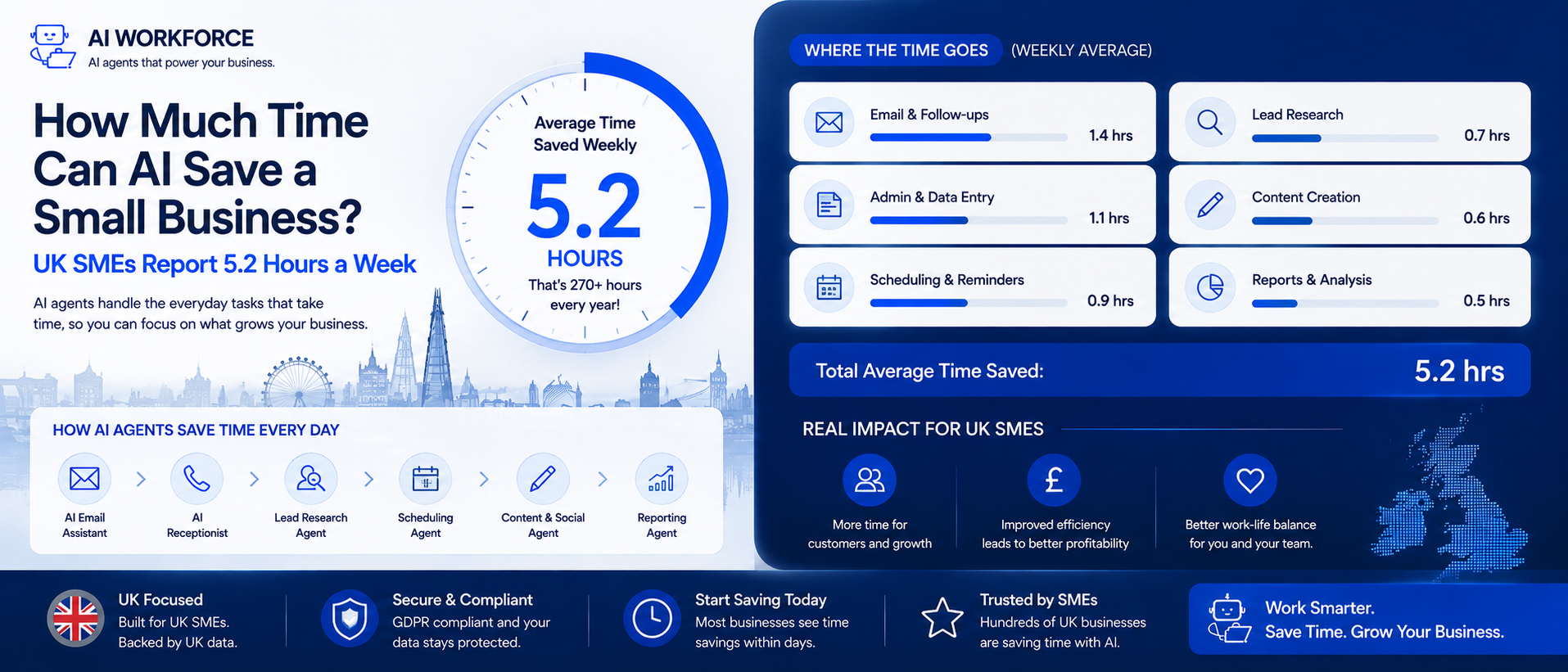
How Much Time Can AI Save a Small Business? UK SMEs Report 5.2 Hours a Week
Posted On: May 14, 2026
Last updated: August 2026
New research shows that UK SMEs using AI are reclaiming hours every week that used to be lost to admin and repetitive tasks. This article breaks down what the figures actually say, what they do not say, and how to work out what a similar shift could look like in your own business.
Quick answer: How much time can AI save a small business? UK research found that SME decision-makers using AI estimate it saves them an average of 5.2 hours a week, a self-reported figure rather than an independently measured one, largely by reducing time spent on research, written communication and repetitive admin. Businesses surveyed said they were redirecting recovered time into strategic planning, creative thinking and improving their products and services.
What the Research Actually Says
According to research commissioned by OpenAI, in partnership with Booking.com and Enterprise Nation and conducted by Opinium, UK SME decision-makers using AI estimate it saves them an average of 5.2 hours a week, more than half a working day. Opinium surveyed 1,000 UK SME decision-makers between 28 February and 12 March 2026.
Research note: the 5.2-hour figure is a self-reported estimate from SME decision-makers, not the result of independently measuring tasks before and after AI was introduced. Results will vary by task, business and implementation quality, and the research itself notes that smaller subgroup findings should be treated as indicative rather than precise.
What the survey found, in summary:
Average estimated time saved: 5.2 hours a week
Most common uses: research and summarisation (47%), emails and business communications (42%), brainstorming (39%)
Where recovered time goes: creative thinking (32%), strategic planning (30%), improving products and services (30%)
Respondents reporting no AI use at all: around one in five (19%)
Sample: 1,000 UK SME decision-makers, fieldwork 28 February to 12 March 2026
Subgroup findings (by region, size or age) are indicative rather than precise, per the source methodology
Where Are the Hours Coming From?
The time savings are not coming from one big process being automated. They accumulate across smaller, recurring tasks: drafting first versions of emails, summarising documents or meetings, and researching before a decision or a piece of work. None of these individually sounds like much. Together, according to the businesses surveyed, they add up to hours a week that most owners would rather spend elsewhere.
AI Workforce Insight: In our experience, businesses rarely notice the biggest time savings on day one. The largest gains usually appear after a few weeks, once staff trust the workflow enough to stop quietly redoing it manually. That is often the point where AI moves from an experiment to a normal part of how the task gets done. This reflects what we see across our own client work rather than a finding from this specific survey.
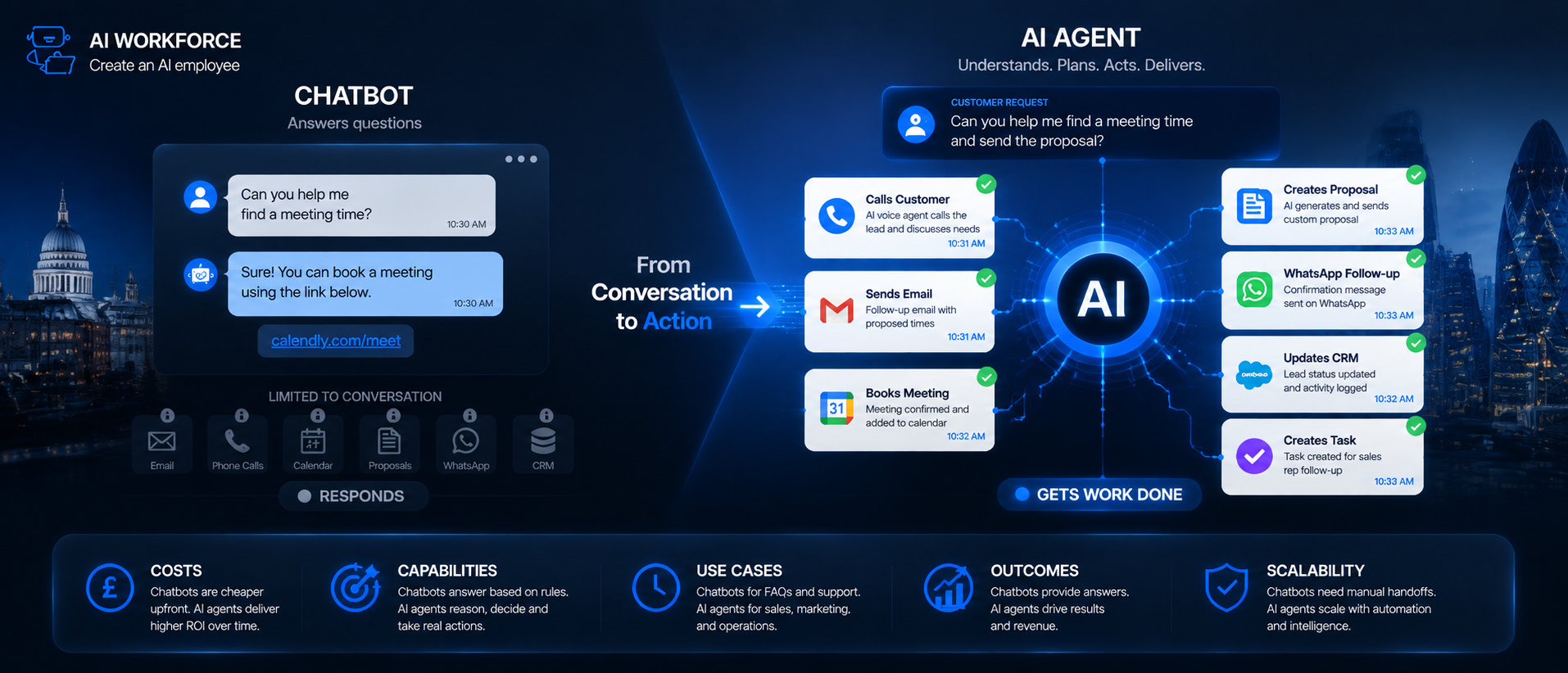
Beyond what this research measured, we also see UK businesses building AI agents for adjacent workflows; an agent that reads an inbound enquiry, checks the CRM for context, and drafts a reply for a human to review is a common example, illustrated below. Again, this is illustrative of where the market is heading rather than a figure from this particular study.
A few concrete examples of what this looks like in practice, based on AI Workforce implementation work rather than the survey itself:
Meeting notes converted automatically into a summary and action list
Routine email replies drafted for a human to check and send
Long-form content repurposed into shorter formats across channels
Lead outreach and follow-ups organised into a single tracked workflow
Signs Your Business Could Save Similar Time
The research is a useful benchmark, but whether it applies to your business depends on a few practical signals. You are a reasonable candidate if:
Your team regularly researches or summarises information before a decision or task
A meaningful share of the week goes on drafting emails or written updates
The same enquiries, requests or admin tasks come up in a similar form each week
Reports are pulled together manually from more than one system
Staff say admin is crowding out customer-facing or higher-value work
If most of these sound familiar, the time-saving potential described in this research is more likely to apply to you too. Our guide to AI agents for small businesses goes into more depth on identifying and scoping that first workflow.
Which SMEs Are Using AI Most Deeply?
The research shows a clear relationship between business size and how deeply AI is used, though it does not report time saved broken down by business size, so the following is about adoption depth, not who saves the most hours. Medium-sized firms automate tasks at a higher rate than smaller businesses (58% versus 37% for micro businesses) and are roughly twice as likely to use AI agents specifically (34% versus 18%). Medium-sized businesses typically have more structured processes, more data to work with, and slightly more resources to configure tools properly, which plausibly contributes to deeper adoption, though the survey does not establish a direct causal link to bigger time savings.
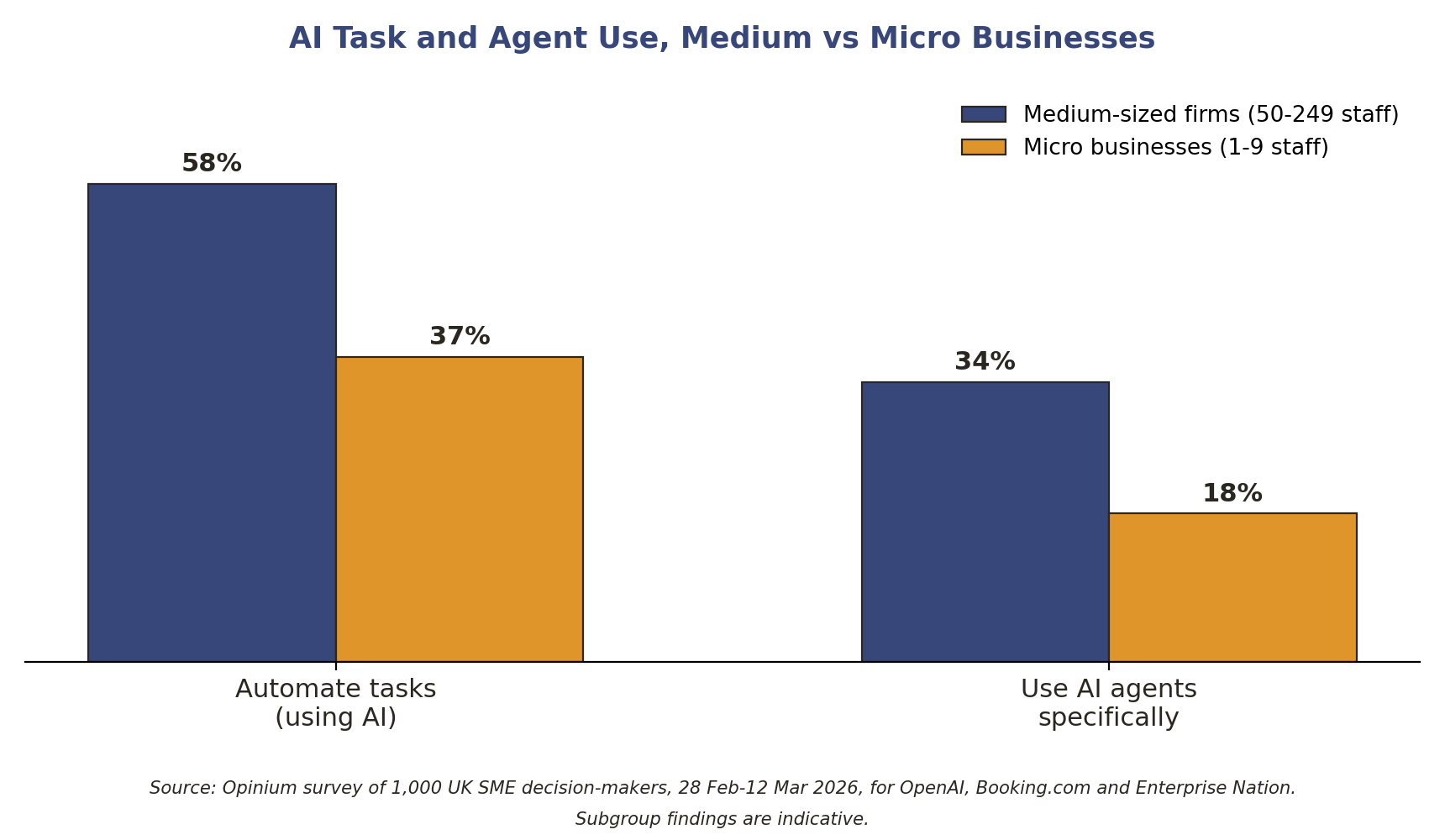
Source: Opinium survey of 1,000 UK SME decision-makers, 28 February to 12 March 2026, for OpenAI, Booking.com and Enterprise Nation. Subgroup findings are indicative.
AI Workforce implementation observation: in our experience, the return on a per-person basis can be just as compelling for smaller teams, even where overall adoption is lower. A sole trader or two-person business that recovers close to half a day a week is effectively adding meaningful capacity without hiring. As a hypothetical illustration, a five-person business recovering a few hours a week across the team would be operating leaner than a similarly sized competitor not using AI at all, though this is an illustrative example rather than a figure from the research.
Industries where tasks are high-volume and well-defined, professional services among them, tend to see faster results in our experience, since the workflow is consistent enough for an AI tool to be configured once and used reliably. Our guide to AI tools for consultants covers this in more depth for professional services specifically. Businesses with highly bespoke or variable processes typically take longer to see a return, in our experience; the survey itself does not measure this directly.
Lower-Risk vs Higher-Risk Tasks to Automate First
Not every task freed up by AI is a sensible first candidate for automation. It helps to think in terms of risk before deciding what to hand over and how closely to supervise it.
Lower-risk, reasonable starting points:
Drafting first versions of routine emails
Research and summarisation ahead of a meeting or decision
Meeting notes and follow-up actions
CRM updates and internal reporting
Higher-risk, keep a human closely involved:
Customer refunds or compensation
Pricing decisions
Financial approvals
Anything resembling legal or regulated advice
This split reflects our own implementation experience rather than a finding from the research, but it is a reasonable starting filter for most small teams.
Is There a Regional Divide?
The research points to a real regional gap in AI adoption. In the survey, 93% of London respondents reported using AI at work, noticeably ahead of the rest of the country, which implies around 7% of London respondents report no AI use at all. By contrast, respondents in Yorkshire and Humber (26%), the South West (28%) and Scotland (24%) reported not using AI at all. Even accounting for that gap, the majority of respondents in every region surveyed report using AI in some form.
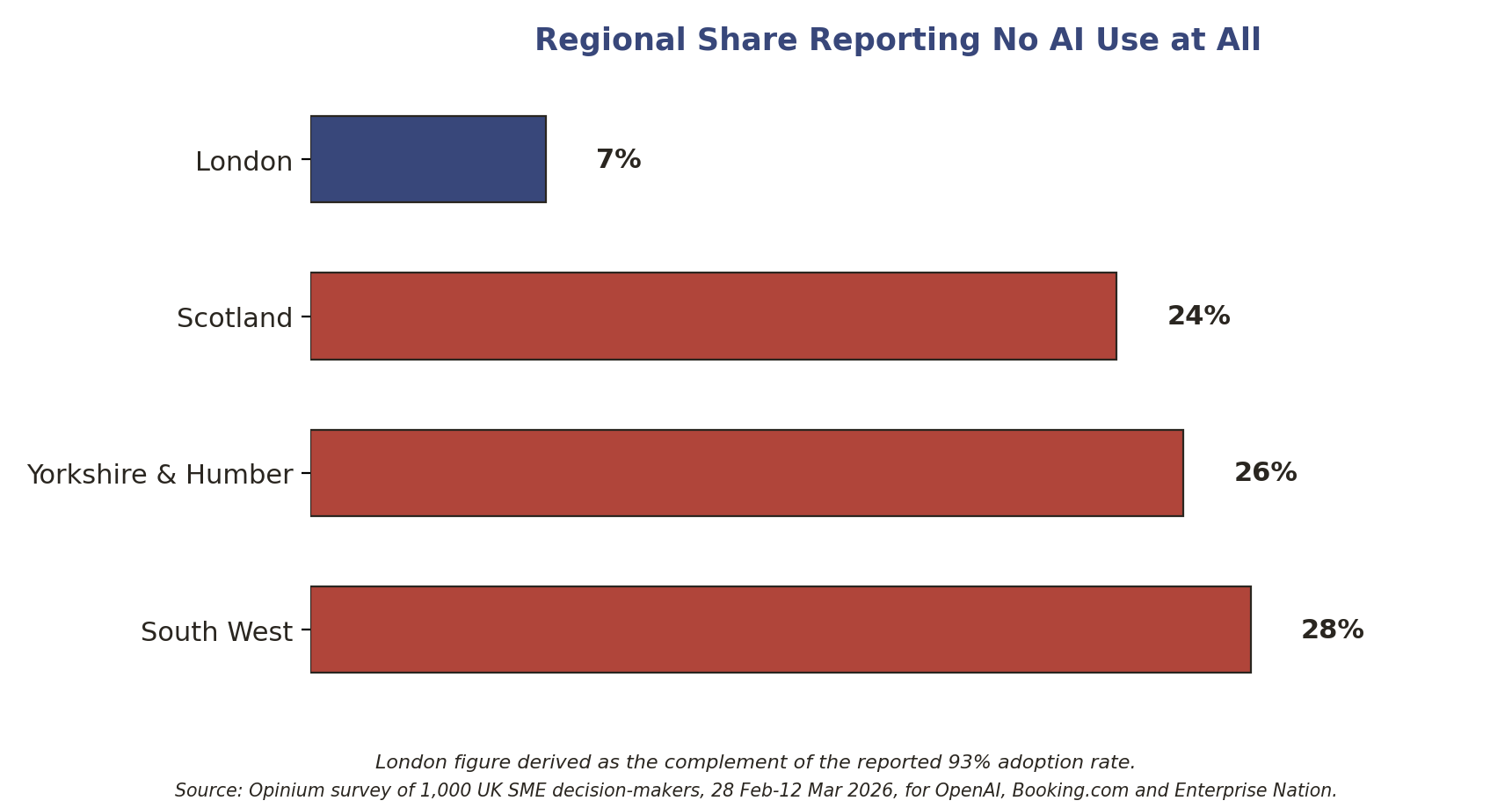
London figure derived as the complement of the reported 93% adoption rate.
Training and skills are a commonly cited barrier among respondents not using AI, mentioned by over one in four (28%) of them. That points to an awareness and confidence problem rather than a technology availability one; businesses know AI exists, but are not always sure where to start or whether it applies to their situation.
The one-day SME AI Accelerator, held in London on 29 April 2026 and hosted jointly by OpenAI, Booking.com and Enterprise Nation, was one attempt to address this skills gap through practical demonstrations, build sessions and peer learning. A recap of the event and its findings is available directly from Enterprise Nation.
What About Micro Businesses and Sole Traders?
The research shows micro businesses and sole traders lag on AI adoption. More than one in three sole traders (37%) and one in four micro businesses (25%) do not use AI at all, compared with just 5% of medium-sized firms. Where AI agents specifically are concerned, fewer than one in five micro businesses (18%) use them, against roughly one in three medium-sized firms (34%).
For micro businesses and sole traders, the barriers are often more personal than technical: time to learn a new tool, uncertainty about whether it will work for their specific situation, and an assumption that AI is built for bigger operations. These are not measured in the research, but they are common themes we hear directly from smaller clients.
In our experience, the potential upside can be larger per person for this group, since a sole trader who recovers even a few hours a week has increased their effective working capacity without hiring anyone. That is an operational observation rather than a conclusion the research draws directly.
Why Are Some Businesses Still Not Using AI?
One in five SMEs overall (19%) still do not use AI at work at all. The research also found a clear age pattern: two in five SME decision-makers aged 55 and over do not use AI at all (40%), compared with fewer than one in ten of those aged 18 to 34 (8%). Confidence follows a similar pattern: fewer than half of decision-makers aged 55 and over feel confident using AI (49%).
This looks less like a capability gap and more like a familiarity and confidence one. Decision-makers who built their businesses without AI have well-developed instincts for what works. In our experience, applying those instincts to evaluating AI tools tends to go more smoothly once the tools are framed around business outcomes, hours saved, fewer errors, and faster response times, rather than technical features or model names.
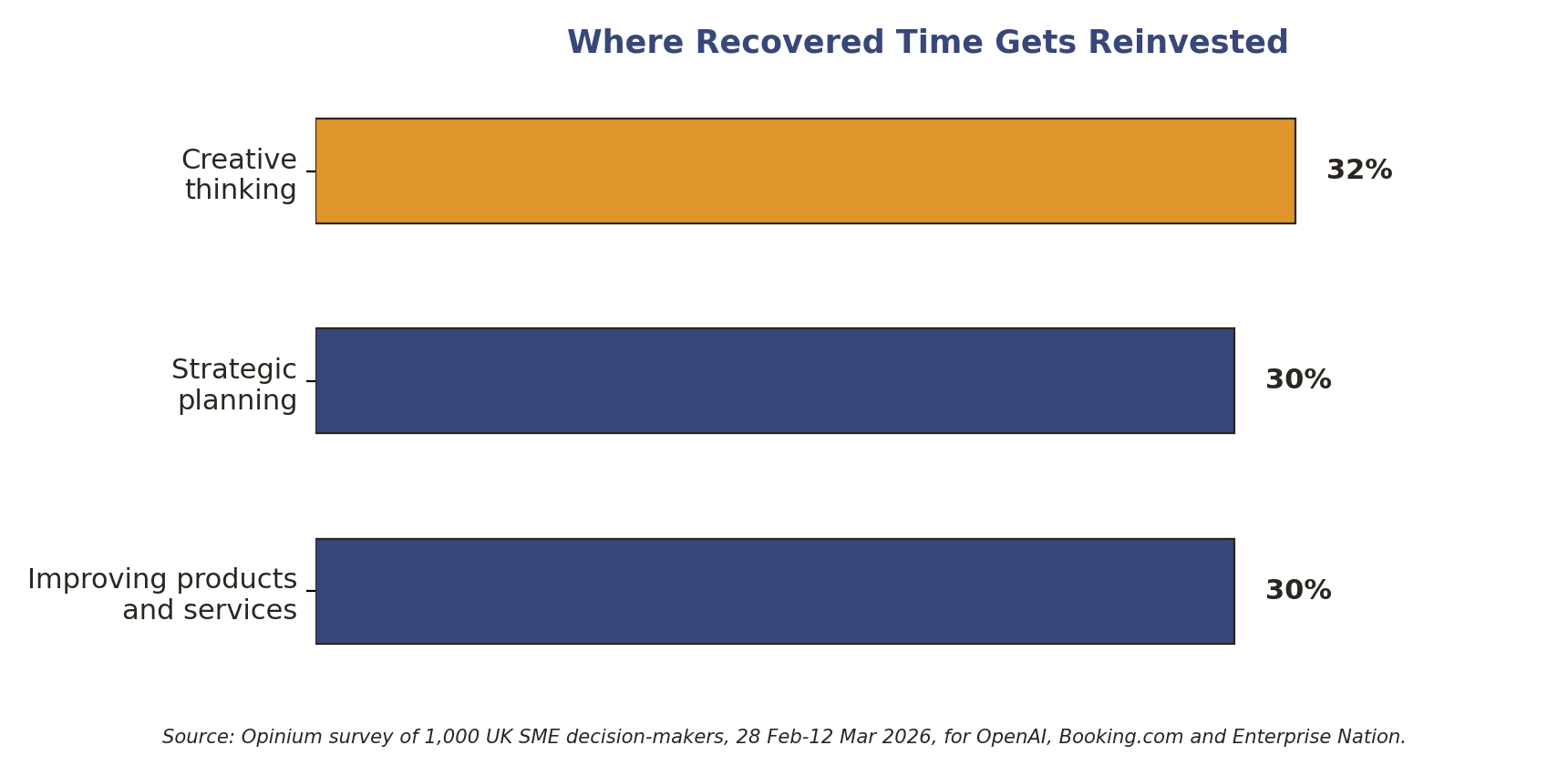
Source: Opinium survey of 1,000 UK SME decision-makers, 28 February to 12 March 2026, for OpenAI, Booking.com and Enterprise Nation.
When AI May Not Save Your Business Time
The headline average reflects estimates from SME decision-makers already using AI, but it does not mean every implementation produced the same result. It is worth being honest that this will not apply everywhere. AI is less likely to save meaningful time when:
The task changes substantially each time it is done, with little repeatable pattern
The underlying data or inputs are incomplete, inconsistent, or scattered across systems
Outputs require extensive expert verification regardless of how good the draft is
The process has never been clearly defined, so there is nothing consistent to automate
Staff are already juggling several overlapping tools for the same job
The task happens too infrequently to justify the setup time
The consequences of an error are disproportionate to the time that could be saved
None of these rule out AI permanently. They usually point to groundwork worth doing first: cleaning up the data, defining the process, or picking a different task to start with.
Governance Before Scaling
Time savings are the headline, but they are easiest to sustain when a small amount of structure sits behind the tools from the start, even for a two- or three-person business. Before scaling beyond a first use case, it is worth having clear answers to:
Named owner: who is accountable for how each AI-assisted task performs
Human review: which outputs get checked before they reach a customer, and by whom
Access permissions: what data and systems each tool or agent can actually reach
Audit logs: a record of what was sent or changed, particularly for anything customer-facing
Review schedule: a regular, even informal, check on quality and errors
Data retention: how long inputs and outputs are kept, and why
None of this needs to be formal for a small team; a shared note covering these points is usually enough to start, and it is far easier to put in place early than to retrofit once several tools are already in use.
Common Mistakes When Chasing Time Savings
Common mistakes to avoid: trying to automate several processes at once instead of proving value on one first, choosing a tool before identifying the actual bottleneck, ignoring the quality of the underlying data or process being automated, measuring how much a tool is used rather than the business outcome it produces, and expecting the time savings to appear immediately rather than after a few weeks of the team trusting the new workflow. Most of these are avoidable by starting narrow and reviewing honestly before expanding.
How to Measure Time Saved
The 5.2 hour figure is a useful benchmark, but the number that matters is your own, and it is worth measuring net time saved rather than gross time saved:
Net time saved = time previously spent − time now spent − review and correction time − ongoing maintenance time
A simple worked example: a task previously took 6 hours a week. With AI assistance, it takes 2 hours, plus 1 hour reviewing and correcting output, plus roughly 30 minutes of tool maintenance. Net saving: 2.5 hours a week, not the full 4 hours a simple before-and-after comparison would suggest.
A short measurement plan over four weeks gives a more honest picture than judging a new workflow in its first days:
Week 1: measure the existing process as it stands today, before changing anything
Week 2: introduce AI with full human review of every output
Week 3: record errors, manual interventions and time actually spent
Week 4: compare net hours saved against week one, then decide whether to continue, adjust or stop
How Do You Get Started?
The most practical starting point is to list every task done more than a few times a week that follows roughly the same pattern each time. That list is your opportunity map. Pick the one that takes the most time and has the clearest, most consistent process. That is your first project. In our experience, the businesses that see results fastest tend to start narrow and expand once the first workflow is proven, rather than automating everything at once, a point covered in more depth in our guide to AI agents for small businesses.
From there, choose a tool built for that specific use case rather than a broad general platform. If the biggest time drain is customer enquiries, AI call centre agents cover what a well-configured setup looks like in practice. If admin tied to invoicing and bookkeeping is the bigger drain, see how accountants use AI to work faster. And if cost is the main open question before you commit to anything, AI automation pricing in the UK breaks down what a first project typically costs against the return.
If you are unsure where to start, structured training, such as a workshop or an event like the SME AI Accelerator, can shorten the learning curve considerably. Peer learning from other owners in a similar position tends to make the examples and takeaways more directly applicable than generic guidance.
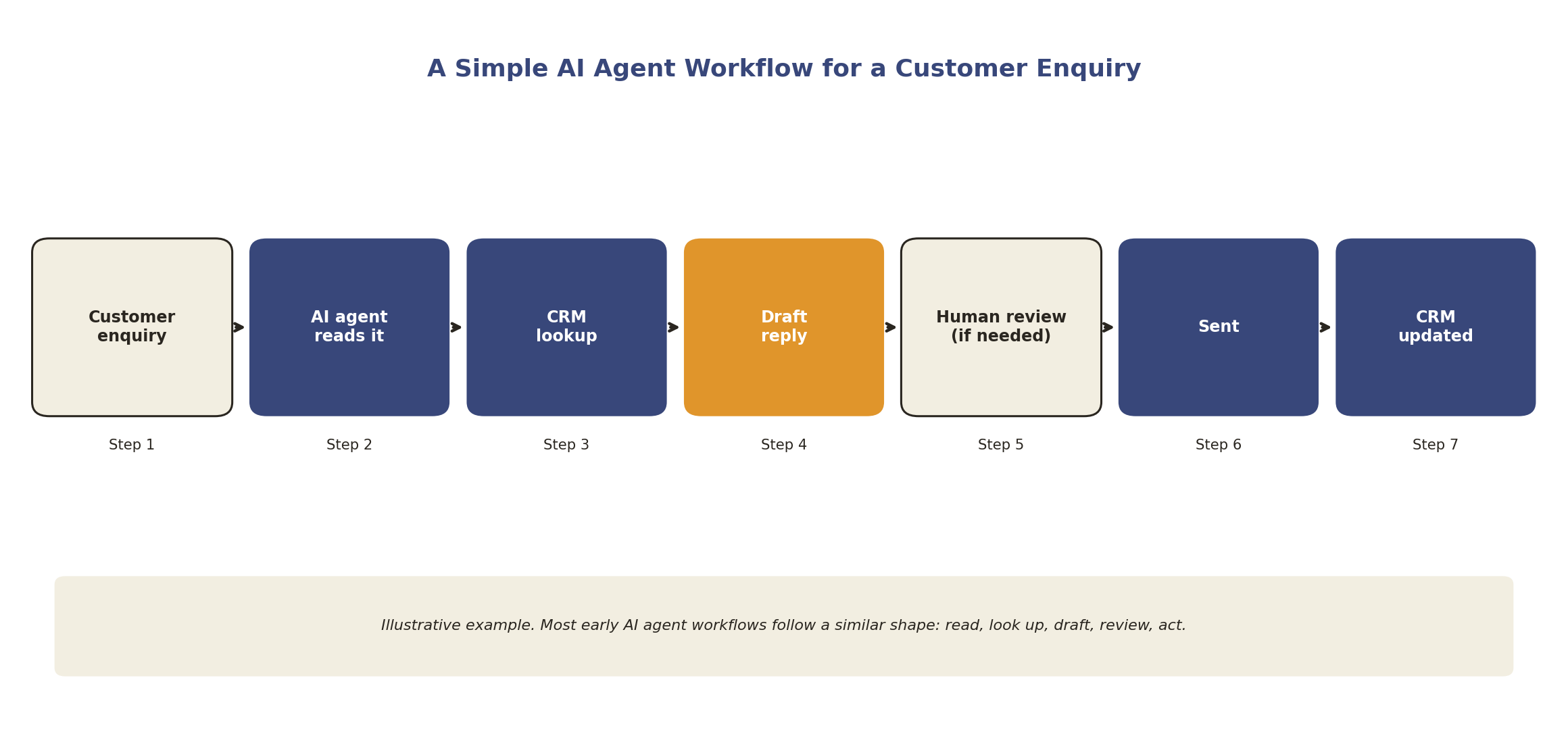
Illustrative example. Most early AI agent workflows follow a similar shape: read, look up, draft, review, act.
What Is the Cost of Delaying AI Adoption?
Delaying is not automatically the wrong call, and rushing unsuitable or badly governed AI adoption can waste as much time and money as waiting too long. But there is a real opportunity cost to consider. Every week that a competitor recovers a few hours and reinvests them into customer relationships, product development or sales activity is a week that any capacity gap between you may grow slightly wider. Whether that matters in practice depends heavily on your sector, your customers' expectations and the behaviour of your competitors. It is not automatic or universal.
The average saving of 5.2 hours a week should not be read as a guarantee. It is an illustration of what becomes possible when repetitive work is redesigned thoughtfully. Businesses do not need complete certainty before testing a low-risk workflow, but they do need a clear baseline, defined safeguards and an agreed point at which the results will be reviewed.
Frequently Asked Questions
How much time can AI actually save a small business?
UK research found SME decision-makers using AI estimate an average saving of 5.2 hours a week. This is a self-reported estimate, and individual results vary considerably depending on the task, the tool, and how consistently the underlying process is followed.
Where does this research come from?
It was commissioned by OpenAI in partnership with Booking.com and Enterprise Nation, with fieldwork carried out by Opinium among 1,000 UK SME decision-makers between 28 February and 12 March 2026.
Do medium-sized firms save more time than smaller ones?
The research shows medium-sized firms adopt AI more deeply, automating tasks and using AI agents at roughly double the rate of micro businesses, but it does not report time saved broken down by business size.
What tasks are UK SMEs actually using AI for?
According to the research, the most common uses are research and summarisation, emails and business communications, and brainstorming, with time saved most often redirected into creative thinking, strategic planning and improving products and services.
Is there a regional gap in AI adoption?
Yes. London leads with 93% of businesses using AI at work, while around a quarter of firms in Yorkshire and Humber, the South West and Scotland report not using AI at all.
When might AI not save my business time?
When the task changes constantly, the underlying data is unreliable, outputs need heavy expert checking regardless, or the task is too infrequent to justify setting anything up. In those cases, it is usually worth fixing the groundwork first.
Do I need to automate everything at once to see results?
No. In our experience, the businesses seeing the strongest results generally start with one well-defined, repetitive task, prove the value, then expand, rather than automating multiple processes simultaneously.
How do I know if the time savings are actually working?
Track net time saved, hours spent before and after AI, minus review and maintenance time, ideally reviewed over four weeks rather than a few days.
Is 5.2 hours a week guaranteed?
No. It is a self-reported average across a survey of 1,000 SME decision-makers, not a promise for any individual business. Treat it as a benchmark worth testing against your own numbers, not a guaranteed outcome.
Key Takeaways
UK SME decision-makers using AI self-report an average saving of 5.2 hours a week, per research commissioned by OpenAI with Booking.com and Enterprise Nation, conducted by Opinium
The most common uses are research and summarisation, emails and communications, and brainstorming, not one single automated process
Medium-sized firms adopt AI more deeply than micro businesses, but the research does not show they save more time per person
Around one in five SMEs still do not use AI at work, with adoption and confidence lower among decision-makers aged 55 and over
Measure net time saved, gross time minus review and maintenance time, over several weeks rather than assuming the headline figure applies to you
Some tasks are not good automation candidates yet, inconsistent processes and messy data are worth fixing first
Ready to Find Out What AI Could Save Your Business?
Book a free AI readiness review to identify your highest-value repetitive workflow, assess its risk level, and agree how results should be measured before you automate anything.
About AI Workforce
AI Workforce helps UK organisations introduce AI safely through practical automation, AI agents and workflow design. We work with businesses to identify suitable use cases, improve productivity and implement AI with appropriate governance and human oversight.
Reviewed: August 2026
Frequently Asked Questions
Everything you need to know about this topic
The SME redesigned its workflow to route repetitive tasks to AI agents, reducing manual handoffs and queuing. Tasks such as data entry, document triage and automated CRM updates were delegated to bots that operate continuously, which collectively saved the team measurable hours per week. This allowed staff to focus on higher-value activities and led to fewer than one in five employees spending time on routine admin tasks by the end of the pilot.
The team automated invoicing, customer follow-ups, scheduling, and repetitive data entry processes. They also implemented automated CRM updates so customer records stayed current without manual intervention. By using AI to automate these routine steps, the company reclaimed extra hours that were previously lost to low-value work.
Yes. OpenAI models and agent frameworks can extract, normalise, and validate data from emails, PDFs and spreadsheets, then feed it into systems of record. When combined with rule-based checks, these models significantly cut the time spent on data entry and helped the SME save time across the week thanks to AI-driven automation.
Time savings vary by task volume and current inefficiencies, but many SMEs report saving several hours per employee each week. In this case study, the deployment of automated CRM updates and other agents reduced repetitive workload substantially, enabling the company to save time and reallocate work to more strategic priorities. Anecdotally, reports show that when such tools are used by 64% of teams in a function, operational bottlenecks decline noticeably.
When you automate data entry, implement validation layers, audit logs and human-in-the-loop checks for edge cases. Use role-based access, encryption in transit and at rest, and periodic sampling to verify accuracy. Combining AI extraction with rule-based reconciliation and human review for critical fields ensures high data quality while maintaining the time savings that help save hours per week.
Small teams can adopt low-code integrations and prebuilt agent templates to deploy AI agents quickly. Start with a single workflow (for example, automated CRM updates or invoice processing), monitor results, then scale. Training existing staff to supervise and tune agents rather than execute repetitive tasks lets teams use AI at work effectively and capture savings without adding headcount.
Leaders should track hours saved per week, error rate reduction, customer response times and redeployed headcount to measure ROI. Expected benefits include faster customer resolution, fewer manual errors and higher employee satisfaction. The case study showed clear week-over-week productivity improvements, with many routine tasks handled automatically, freeing staff for revenue-generating work.
Common barriers include fear of incorrect outputs, integration complexity and lack of clear ownership. In the case study, these were overcome by starting small, demonstrating quick wins (such as automated CRM updates and reduced data entry time), and establishing governance with clear escalation paths. Communicating wins—like saved hours per week and reduced backlog—helped drive broader adoption after initial scepticism.