15 Best AI Email Assistants for 2026
Posted On: July 31, 2026
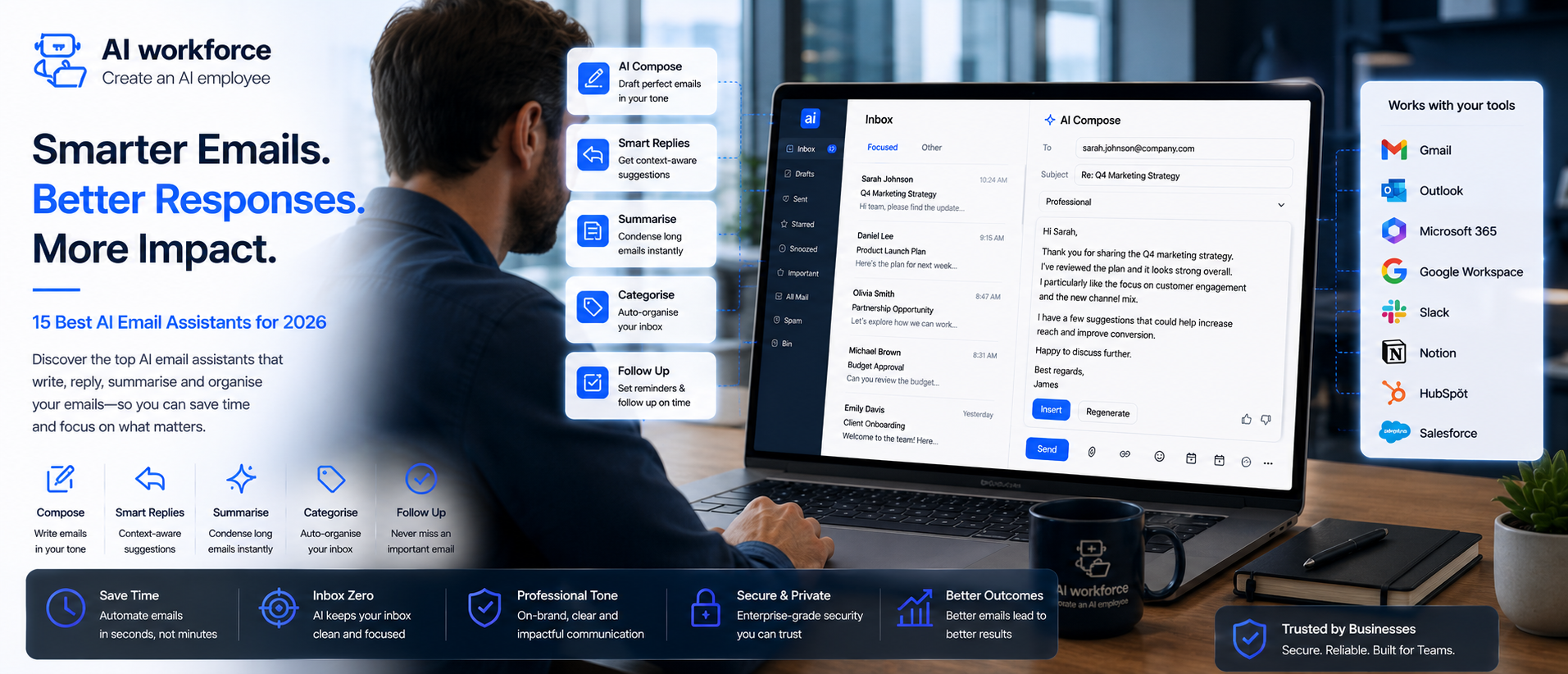
An AI email assistant in 2026 does a lot more than flag spam: it drafts replies, sorts what matters, and quietly handles inbox management while you focus on everything else. This guide rounds up the best AI email assistant options worth using, from a simple AI agent that drafts a reply to a full AI email assistant built right in, and shows how to use AI without losing control of your own inbox.
What Makes an AI Email Assistant Different From Autoreply?
Most inboxes have had basic autoreply for years; what's different now is an AI model that actually understands what an email is asking for, not just matching keywords. Generative AI writes a genuinely usable first draft, and native AI built into the email client itself works faster than a bolted-on plugin ever could.
AI features worth paying attention to include tone matching, thread summarisation, and priority sorting, the kind of AI assistant capability that used to need a dedicated tool for each one. When the AI reads an incoming email correctly, the reply it drafts needs barely any editing.
How Do You Actually Manage a Full Inbox?
Keep your inbox under control by letting AI manage your inbox for the repetitive parts, sorting, snoozing, and archiving, while you handle anything that actually needs judgement. Organise your inbox once with a few rules and most of the future sorting happens automatically.
A split inbox, one view for what needs a reply today and another for everything else, works well for people who get too many messages to read every single one in order. Inbox management tools like this turn constant new mail into something that feels manageable within a few minutes each morning.
Which Tools Work Directly Inside Your Email Apps?
Gemini for Gmail works natively inside Gmail itself, no separate app required, while Gemini in Gmail specifically handles drafting and summarising within the same window you already have open. Whether you're on Gmail or Outlook, the built-in option is usually the fastest to set up.
Microsoft Copilot for Outlook takes the same approach from the other side: it lives directly in the ribbon, and an assistant for Outlook built this way never asks you to leave the app to get a summary or a suggested reply. For email addresses ending in Microsoft-related domains, this kind of integration tends to be the most seamless.
Not every setup handles Gmail and Outlook equally well, though: one tool connects to Gmail smoothly, but struggles elsewhere, and Gmail without the desktop app installed can limit what a browser-based AI assistant can actually see.
Can AI Draft Replies and Handle the Basics?
AI draft quality has improved enormously: an assistant that drafts replies now picks up on tone, context from the thread, and even your own past phrasing, so what comes back barely needs editing. Let AI handle every email that's clearly routine, and step in yourself only for the ones that need a human judgement call.
AI triage sorts the entire email pile the moment it lands: urgent client messages surface first, newsletters and receipts drop to the bottom automatically. If you want ai to handle this quietly in the background, most tools let you set the aggressiveness of the sorting yourself.
Reviewing an existing email thread before drafting a reply matters too: want an ai that reads the last ten messages for context, not just the one you're replying to, so the suggested reply actually fits the conversation.
How Does This Kind of Tool Handle Your Inbox Day to Day?
An AI email agent works differently from a tool that just files messages into folders: it takes action on your behalf, drafting, scheduling, even flagging something for follow-up, the way you use an AI tool should if you're going to trust it with your inbox at all.
Use AI this way, and most tasks stay in the inbox without leaving territory: everything happens inside your inbox rather than bouncing between five different apps to get one thing done.
Inbox access should be scoped carefully, read-only for some integrations, full read-and-write for others, and inbox data ideally never leaves the provider you already trust. A tool that behaves like your inbox normally does, just faster, is usually the safest one to hand real access to.
How Far Should It Go Beyond Your Inbox?
Some tools position themselves as little more than a smarter inbox; others aim to be the best AI personal assistant you have, handling email alongside your calendar and your task list. That distinction matters: a tool that only touches email is still useful, but one that spans your whole day is a bigger commitment to set up properly.
None of this replaces a human assistant for anything genuinely complex: relationship management, sensitive negotiations, judgement calls with real consequences. Think of it as closer to an executive assistant for the routine 80% of your personal email, freeing up the time you'd otherwise spend on the boring parts.
A personal inbox gets different treatment from a shared team one, too: tone matters more, and false positives on urgency are more annoying when nobody else is watching the same queue.
What About Finding Old Messages Fast?
AI search finds a message by describing it in plain English, "the invoice from March", rather than remembering the exact sender or subject line. Email search this way saves the five minutes you'd otherwise spend scrolling and guessing at the right folder.
Email history matters for context too: based on emails you've sent before, a good tool learns your usual tone and reuses it automatically, so replies sound like you rather than generic corporate copy. You shouldn't have to open an email just to check whether it needs a response before deciding what to do with it.
Some tasks still need you inside an email itself, reviewing an attachment or checking a detail before replying properly, and that's fine: an AI inbox should support that workflow, not try to remove you from it entirely.
Which Tools Handle Team and Group Inboxes Well?
A shared inbox, support@ or sales@ rather than a named person, needs different features entirely: assignment, internal notes, and a clear record of who replied to what. The best for teams options handle this without turning into a second project management tool nobody wanted.
Task management and email management increasingly overlap: turn a message into a task with one click, and it shows up wherever your team already tracks work rather than living only in one place. AI email management this way keeps everything in one place instead of duplicating effort across two systems.
Email scheduling rounds this out nicely: queue a reply to send at a sensible hour instead of the moment you happen to write it, which matters more than people expect once a team spans more than one timezone.
Which AI Email Tools Actually Stand Out for 2026?
Superhuman AI built its name on speed before adding drafting and triage on top, a premium option for people who live in their inbox all day. Meli AI takes a lighter-weight approach, focused specifically on small business inboxes rather than enterprise scale. Mailbutler adds AI extras directly into your existing setup via a plugin, keeping the interface you already know.
Beyond the big names, AI tools built specifically for email content and email writers deserve a look too: some specialise in an email service for cold outreach, others focus purely on internal email work and getting replies out faster.
AI capabilities vary a lot between these tools, so match the feature set to what you actually need: some teams just want a smarter email experience day to day, others want deeper AI-powered email analytics on response times and volume. Areas where AI can help most obviously include drafting, sorting, and summarising, smart email handling the rest quietly in the background.
Is a Best AI Email Assistant Actually Worth Setting Up?
AI email assistants help most people the moment drafting and sorting stop needing manual attention, which for most inboxes happens within the first week of real use. AI for email isn't a gimmick anymore: it's closer to a genuine productivity layer than a novelty feature bolted onto an existing client.
Email with AI handled well means less time spent context-switching and more time on the work that actually needs a person. If you've been putting off setting one up, this is a reasonable moment to start, given how far the underlying models have come in the last year alone.
A well-configured inbox assistant should feel like a better version of your existing inbox experience, not a replacement for it.
Key Takeaways
AI handles drafting, sorting, and triage so replies barely need editing
Both major email platforms now have genuinely built-in AI options
A team inbox needs different features to a personal one
Search and history matter as much as drafting for saving real time
Free and paid tiers both cover the basics well in 2026
Task handoff and scheduling matter more once a team gets larger
The best options fit into how you already work rather than replacing it
Ready to Take Control of Your Inbox?
If you're still typing every reply from scratch, it's worth seeing how much of that can be automated without losing your own voice. Get in touch, and we'll help you find the right starting point.